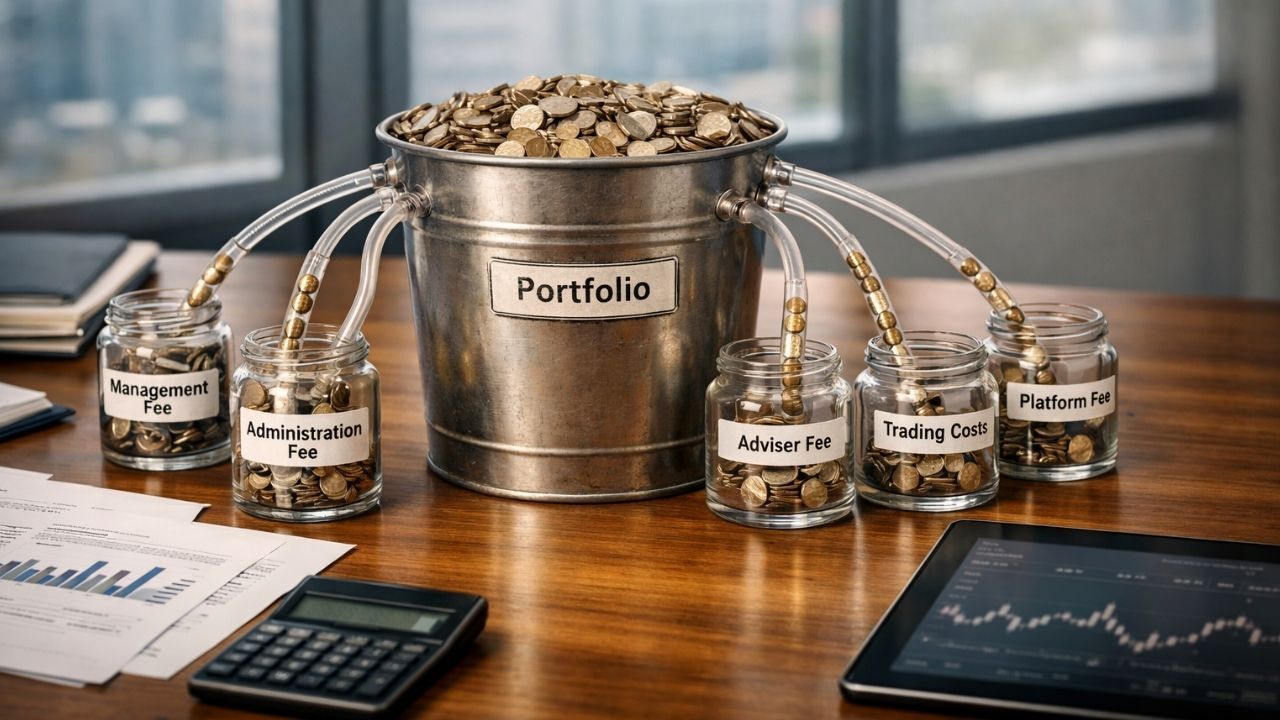
When most people look at their superannuation or investment statements, they look for one number.
But the reality of what you are paying is often buried in the fine print.
Many funds—particularly superannuation providers—will prominently display their Administration Fee while keeping other costs obscured. Planners will display the advice cost and downplay the others. And most will bury the internal costs.
To truly understand what your investment is costing you, you need to work out how much each of the following is costing you.
1. Administration Fees
This is the "overhead" of the fund. It covers the registry services, the cost of sending you statements, the call center staff, and the legal compliance of the fund. Because this is the most "visible" fee, many funds compete on this number alone, even if their other fees are significantly higher.
If you are invested in a managed fund or a managed account, this will be the platform fee.
Things to note:
-
Super funds and Wraps often focus on this fee, because the investment fees can be variable. Don't be fooled into thinking it is the only fee!
-
Managed funds or ETFs will ignore this fee, because they don't know what platform you are investing through
-
Lots of platforms pay you a much lower rate on cash than what they earn. This is effectively a fee. For most of our clients this is a rounding error in the 4th decimal place, but if you are carrying larger cash balances this can be meaningful.
- If you are invested with a stock broker this is probably zero.
2. Investment Fees
This is what you pay the portfolio managers to actually pick the stocks, bonds, or assets.
This covers the research, the analysts, and the software used to manage the portfolio. Generally, "Passive" or Index funds have very low investment fees, while "Active" managers charge more for the promise of beating the market.
Things to note:
-
Sometimes you have layered investments. An asset allocation manager might buy other exchange traded funds or management funds. The "top level" will usually make their own fee clear, but you need to be aware if you are accruing fees at other "layers" that you might not be aware of.
-
Private equity and other unlisted asset managers can have separate arrangements which you might not be aware of. Maybe you are paying them to manage your investments, and they are being paid by the company that you are invested in as a consultant or director. These payments can be significant.
3. Embedded Fees (ICR)
Embedded fees (often referred to as the Indirect Cost Ratio or ICR) are costs that are "stripped out" of the underlying investment before the unit price is even calculated.
Things to note:
-
The Invisible Fee: These are not explicitly charged to your account as a dollar amount. Instead, they reduce the investment return of the fund itself.
-
If your fund invests in other funds, those underlying funds charge fees that are "embedded" in the price, making the total cost of ownership much higher than the headline rate suggests.
-
If you invest through a platform, you won't see this fee on your end of year statement. Particularly an issue with Exchange Traded Funds.
4. Advice Fees
If you have a financial adviser linked to your account, their professional fee is often deducted directly from your balance. This is a fee for the strategy and planning provided to you personally, rather than the management of the underlying investments.
Things to note:
5. Performance Fees
Performance fees are a "bonus" paid to a manager for overperforming a specific benchmark. While they sound fair in theory (you only pay if they win), they are often structurally flawed.
Things to note:
-
High Water Marks: Does the manager have to make up previous losses before charging a fee again?
-
Easy Benchmarks: Is the manager getting a bonus just for the market going up, rather than their own skill?
-
or a deeper dive into why these fees can be problematic, see this detailed analysis on Performance Fees
6. Transaction Costs
This is one of the most misunderstood areas of investing. These are the costs incurred when the fund buys or sells assets (brokerage, stamp duty, etc.).
These are almost invariably hidden - the only way you see them is from more reputable managers who own up to them or comparisons from regulators like APRA who demand to see the full details.
Note that you will usually not see these on any statement.
-
The Turnover Trap: The more a manager trades, the higher these fees become.
-
Hidden in the Spread: For ETFs and Managed Funds, these costs are often hidden within the buy/sell spread. You don't see a line item on your statement for these; instead, the value of your units is simply worth slightly less the moment you buy them.
-
Foreign exchange rorts: you are investing in international shares (like Apple or Microsoft), you have to convert your local currency to USD. Many platforms claim "Zero Commission" trading but hide a massive 0.60% to 1.00% fee in the currency conversion. See here for an example Interactive Brokers Pricing
- When you compare (say) investing directly in exchange traded funds vs buying through a fund you should take this into account. For example, adding $100 a month to a fund like our individual accounts where we buy fractional shares would cost you $0.09 each time. If you are paying $5 a trade then you are losing 5% before you even start.