
Oil, Helium, Fertilisers and a Slow-Motion Supply Chain Squeeze

Are Supply Chains Breaking Again?
If you read the headlines today, you might think we are on the verge of another massive supply chain crisis. Freight costs are ticking upward, the Strait of Hormuz is a geopolitical flashpoint, and inflation expectations remain stubbornly embedded.
It is easy to look at the current landscape and feel a sense of déjà vu. During the COVID-19 pandemic and the onset of the Ukraine war, supply chain disruptions brought the global economy to a standstill. The natural reaction is to assume we are heading right back into the same catastrophic shortages.
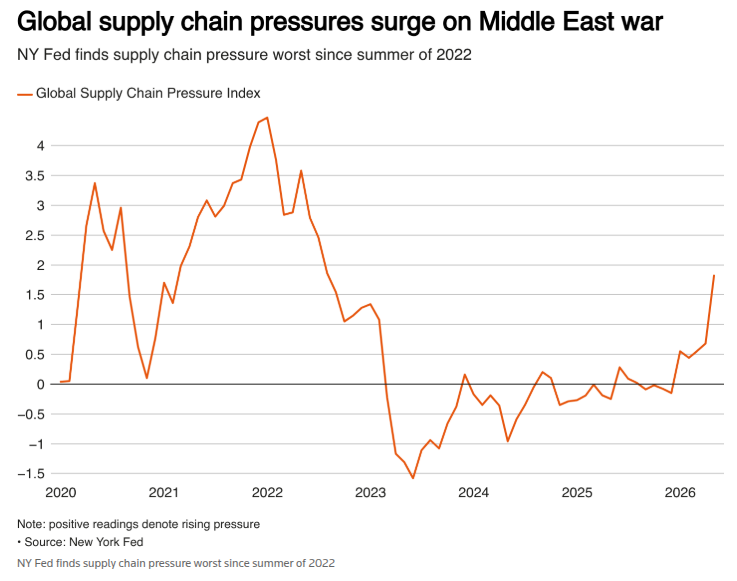
However, our interpretation of the current data—and the commentary coming out of corporate earnings reports—suggests a different, more nuanced story. While the situation is fraught with uncertainty, the most likely reason for what we are seeing is that supply chains are bending, not breaking. We believe we are navigating a slow-motion squeeze rather than an immediate collapse.
But we must be clear about a critical caveat: If the Strait of Hormuz is closed for a significant period of time, then the analysis you are about to read is wrong. A prolonged closure would trigger an acute crisis. Assuming that worst-case scenario is avoided, here is our interpretation of what is actually happening in global supply chains, the range of potential outcomes, and what it means for your portfolio.
The "Safety Stock" Buffer: Interpreting the Data
Why aren't we seeing a repeat of the 2020 supply chain collapse yet? The most likely explanation is that companies learned their lesson.
Supply chain management and energy chain resilience have become paramount. Prior to the pandemic, corporations relied heavily on just-in-time manufacturing and single-supplier dependencies. Today, the "China plus one" strategy is standard practice. Companies have built up larger buffers and diversified their suppliers.
What we are seeing right now in the global Purchasing Managers' Indexes (PMIs) isn't necessarily a sign of imminent shortages, but rather companies aggressively rebuilding "safety stock."
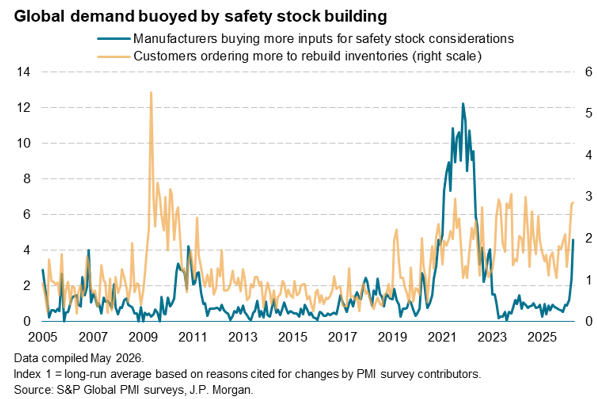
Much like the toilet paper hoarding of 2020, manufacturers appear to be buying more inputs than they immediately need just to be safe. This behaviour pushes prices higher, and strains the system right now. But it also, temporarily at least, indicates some future insulation from catastrophic breaking points.
Breaking Down the Supply Chain: Sector by Sector
To understand the risks, we have to look past the broad macroeconomic numbers and examine the specific commodities.
Helium: Innovation May Beat Shortages
The Middle East supplies roughly a third of the world's helium, which is critical for manufacturing semiconductors and high-end hard drives. While this sounds alarming, the high-end chip manufacturers appear to have adapted by investing in recycling processes that capture and reuse up to 95% of their helium.
Lower-end chip manufacturing and certain medical imaging uses (like MRIs) may face some price rationing, but overall, it seems the tech industry has engineered a buffer against an acute helium disaster.
Fertilisers: A Delayed Shock
Fertiliser prices have spiked, which will inevitably lead to higher food prices. However, this is a delayed shock—crops being planted today with expensive fertiliser will be harvested and sold in six to twelve months. Furthermore, this will predominantly impact developing nations. In the developed world, the cost of the raw wheat in a loaf of bread is only a fraction of the final retail price, meaning we will see some inflation, but the true humanitarian risks will be concentrated in emerging markets.
Plastics, Chemicals, and Aluminium
We are seeing isolated shortages in specific supply chains—such as paint thinners for cars in Japan—but there are currently no broad-based warnings from global manufacturers that production is grinding to a halt. Aluminium is similarly insulated. It is affecting a few automakers that rely heavily on it, but in its broader use, aluminium has readily available substitutes like steel or wood for other industrial or building uses. The primary outcome here is likely to be higher prices for specific goods, not a systemic manufacturing shutdown.
Oil and Energy: The Big Threat
Oil remains the most significant risk. Roughly 20% of the world's oil traditionally flows through the Strait of Hormuz. If that chokepoint were to close completely, alternative pipelines and increased production from other nations (like US fracking) could cover a portion of the shortfall. However, we would still be left with a global demand gap of around 5% to 10%. Closing that gap would require severe "demand destruction"—meaning oil prices would need to skyrocket to $150, $200, or higher to force people to consume less. This is the scenario that would cause genuine economic damage.
But, if some ships are getting through, and the demand gap is more like 3-5%, then the economic damage might be considerably less.
The Range of Potential Outcomes
There is no single guaranteed outcome here. We are monitoring a range of different geopolitical scenarios, each carrying distinct probabilities and vastly different investment implications:
- The "Grand Deal" (Low Probability): A comprehensive peace agreement is reached. Investment Impact: Highly positive for global economic growth. Inflationary pressures ease, and equity markets rally.
- Return to War / Strait Closure (Lower Probability, High Impact): Active conflict resumes, or the Strait of Hormuz is closed for a significant period. Investment Impact: Dire. This would invalidate our baseline analysis, leading to severe energy shortages, massive inflation, and a likely global recession.
- The "Iranian Toll Booth" (Lower Probability): The US declares a quiet victory and sails away, leaving an unofficial "toll" to be extracted, adding a few dollars to a barrel of oil. Investment Impact: A manageable headwind. The global economy absorbs the slightly higher cost while alternative pipelines are built.
- The Ambiguous Status Quo (Most Likely): There is no official resolution. A detente is reached, some ships get through, others don't. Maybe there is an "unofficial toll". A Chinese/Indian ship filled with Saudi oil might be allowed through. A US/European ship or Iranian oil might not. Investment Impact: Oil prices remain elevated—acting as an economic handbrake—but they do not spike to the levels required to force massive demand destruction.
What This Means for Your Portfolio
So, how should a savvy investor navigate a world of probabilistic outcomes and supply chain ambiguity?
1. Acknowledge the Earnings Boom (With Caution) Despite the dark clouds of inflation and geopolitical risk, corporate earnings are looking remarkably strong. The broader US market is tracking toward nearly 20% earnings growth this year. If the worst-case scenarios are avoided, staying completely out of the market out of fear means you risk missing out on a period of exceptional corporate profitability.
2. Beware of "Excuse-flation" Inflation expectations are becoming locked in. We are seeing a phenomenon we call "excuse-flation"—where companies with strong pricing power use the excuse of supply chain issues to aggressively raise their prices and pad their margins. For example, a company might face a 50% increase in the cost of a raw material that only makes up a fraction of their total expenses. Yet, they will raise the final retail price by a full dollar, increasing their profit margin. As an investor, you want to hold the businesses that have the pricing power to pass costs onto consumers, and avoid commodity-dependent suppliers who are getting squeezed by higher input costs.
3. Don't Fight the Last War The biggest mistake you can make right now is assuming the future will look exactly like the recent past. We recently lived through a major supply chain crisis, and it is tempting to view every new disruption through that lens. Stay vigilant. Ensure your portfolio has defensive positions—such as short-term or inflation-linked bonds—to protect against embedded inflation and the tail risk of the Strait closing. But recognise that beneath the alarming headlines, if the global supply chain continues to bend without breaking, a massive profit boom is currently underway.