

Australian property market February 2026 update

From an analytical standpoint, Australia’s housing market continues to present some of the most stretched affordability conditions in its recorded history. In reviewing the data across wages, rents, inflation dynamics, and interest-rate settings, it is clear that the primary constraints on the system are now structural rather than cyclical.
My goal in this article is to outline the mechanisms behind current affordability pressures, quantify where the extremes lie, and identify which economic indicators matter most for forecasting medium-term outcomes. For more detail on individual markets, see here.
Why Housing Defies Traditional Valuation Models
Housing is uniquely challenging to value because it functions simultaneously as an investment asset and a consumption good. This dual purpose means investment metrics — such as yields or long-term growth assumptions — often fail to capture real-world demand constraints. Buyers do not respond solely to expected returns; they respond to the need for shelter, borrowing capacity, and the relative cost of renting versus owning.
To address these nuances, an affordability model is used that measures:
- Mortgage payments relative to wages,
- Mortgage payments relative to rents, and
- Property prices relative to wages.
These metrics allow us to gauge serviceability pressures, assess buy/sell incentives, and benchmark current market conditions against historical norms.
Core Affordability Metrics
1. Mortgage Payments to Median Wages
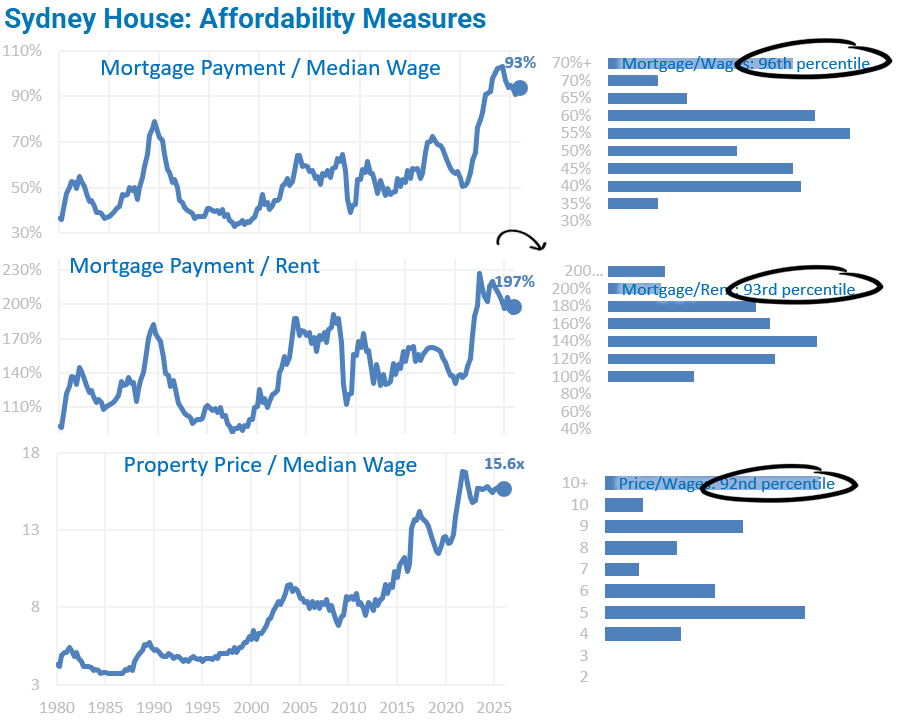
This metric captures the portion of a full-time pre-tax income required to service an 80% LVR mortgage. When this ratio exceeds 90%, the market enters historically rare territory where the typical household must allocate nearly a full wage to repayments.
Sydney currently sits around the 96th percentile of its historical range. For context, the long-term median sits closer to 60%, underscoring the severity of current affordability distortions.
2. Mortgage Payments to Rents
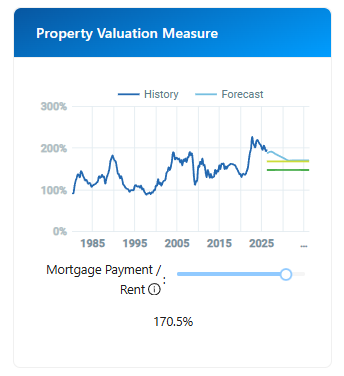
Rent acts as an equilibrium anchor because renters can substitute between renting and buying. Historically, Sydney’s mortgage-to-rent ratio sits between 140% and 170%. Today it is closer to 190–200%, signalling extremely weak economic incentives to purchase relative to renting.
Sustained deviations from equilibrium typically resolve through some combination of falling real prices, rising wages, or lower interest rates.
3. Prices to Wages
This ratio highlights entry barriers but has diminishing relevance once households enter the market. Over time, serviceability conditions — not entry costs — dictate sustainability. Still, the ratio illustrates the long-term decoupling between incomes and housing values across major cities.
Interest Rates as the Dominant Driver of Affordability
Interest rates, determined by the Reserve Bank of Australia via adjustments to the cash rate, pass through directly to variable and fixed mortgage products. While incumbent borrowers tend to absorb rate changes without forced selling, new entrants are fully exposed to the current mortgage environment.
Most new borrowers select the lowest effective rate available at the time — typically discounted variable or short-term fixed options. Our affordability model uses the minimum of these choices, a method that reflects how the marginal buyer sets prices across the market.
The ultra-low-rate environment of 2020–2022 greatly expanded purchasing capacity. Subsequent rate increases have acted as the largest single contributor to the deterioration in affordability since then. The question now is whether the current rate regime is transitory or represents a higher structural baseline. This distinction has significant implications for future price trajectories.
Rental Market Dynamics: Boom or Reversion?
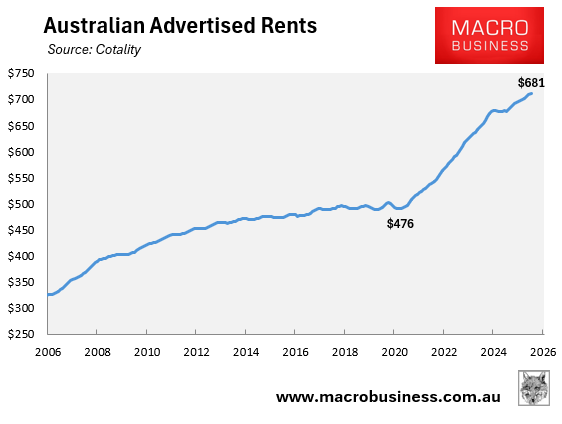
Post-COVID, advertised rents grew at one of the fastest paces on record, driven by acute supply shortages and historically low vacancy rates. The critical question is whether Australia has entered a phase of structurally higher rental growth or whether this surge will revert to the long-run trend.
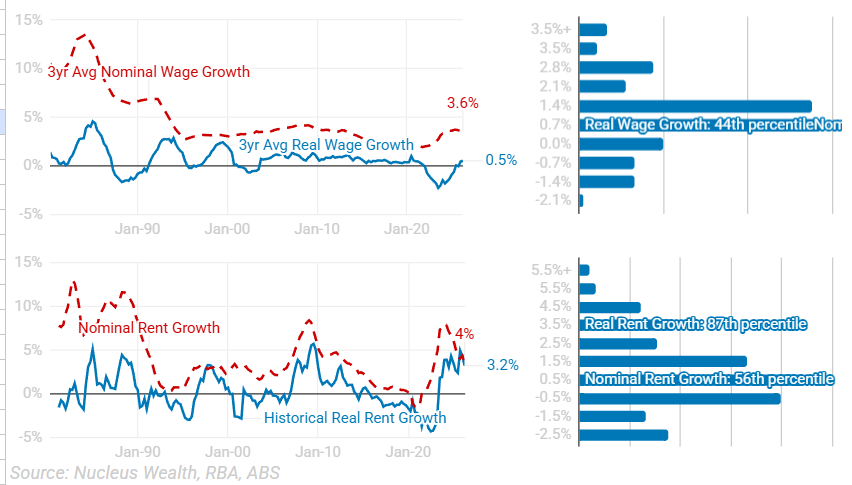
Historical real rental growth (rent increases minus inflation) averages approximately 0%. Between 2010 and 2020, real rental growth was slightly negative. Sustained real increases require population growth that materially and persistently exceeds new supply — a condition that has not held over long periods.
Moreover, older stock often underperforms average figures unless upgraded, meaning even stable nominal rental growth may still translate into negative real returns for unrenovated properties.
Wages: The Primary Structural Constraint
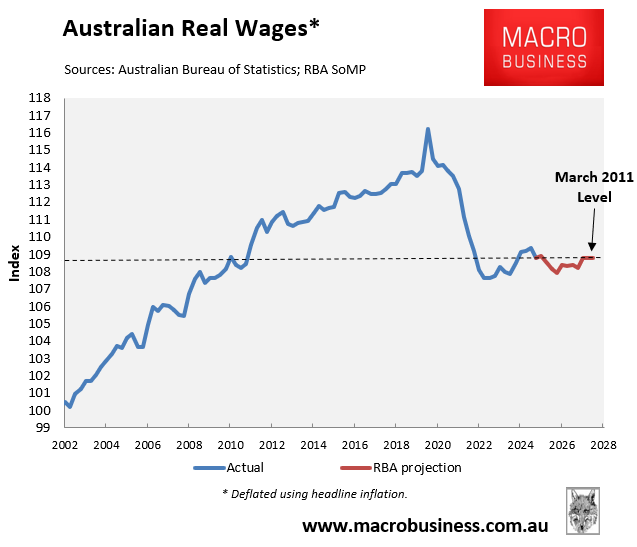
Real wage growth remains the critical limiting factor for Australian housing. Over the past 15 years, real wages have been either stagnant or negative. Recent data shows:
- Nominal WPI growth: ~3.6%
- Real wage growth: ~0.5% (three-year average)
- Public sector: ~4%
- Private sector: ~3%
Given that the private sector represents the bulk of employment, its weaker growth profile constrains overall household borrowing capacity. Without a sustained lift in real wages, the market’s ability to absorb higher mortgage costs is limited.
This is one of the primary reasons the current affordability environment cannot rely solely on population growth or supply constraints to justify higher prices.
Inflation Composition and Its Role in Mortgage Rates
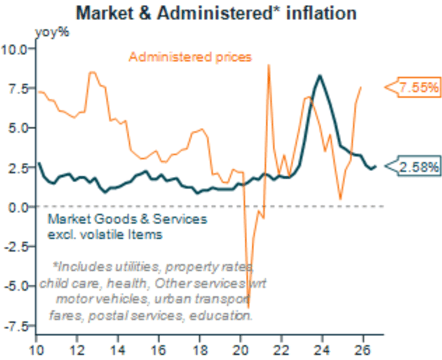
Inflation, as measured by the CPI, remains elevated, but the composition matters. Market-driven goods and services have shown little inflationary pressure, while administered prices — those heavily influenced by government — have risen sharply. These include:
- utilities,
- council rates,
- childcare,
- education,
- regulated healthcare services.
This skewed inflation has kept headline CPI high and prolonged pressure on interest rates, despite falling output prices in the business sector.
From a forecasting perspective, a convergence between administered inflation and market inflation is critical. Without it, mortgage rates may remain structurally high, delaying any meaningful recovery in affordability.
Property Investment Calculator: Quantifying Real Outcomes
Using our property investment calculator (available via the Nucleus Wealth website) illustrates the practical implications. Consider a $1.5 million Sydney house:
- Deposit: $200,000 (87% LVR)
- Rent: median, adjustable
Here are the core assumptions (change them yourself to see the effect)
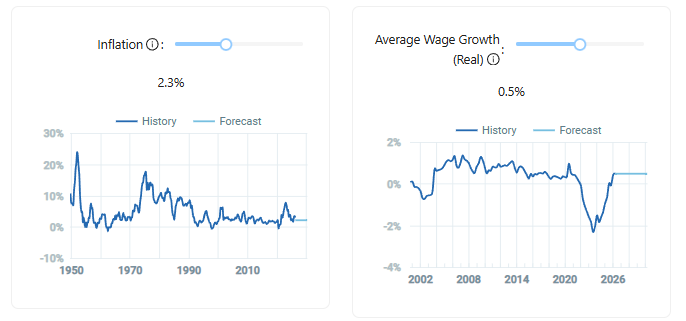
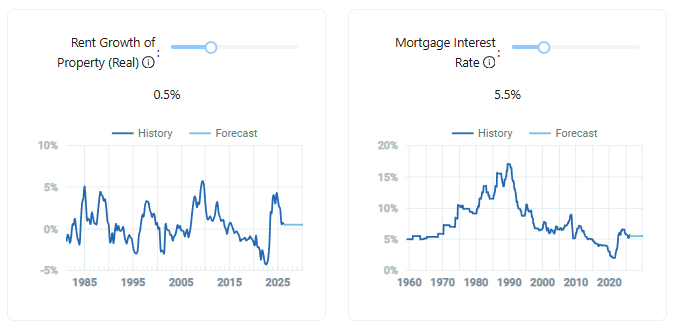
Key assumption: Mortgage Payment/rent ratio goes back to its 10 year average
Ten-year outcome estimates:
- Without leverage: roughly +$50,000
- With typical leverage: a loss of -$500,000, driven by:
- interest costs,
- transaction expenses (including stamp duty),
- maintenance and operating expenditure.
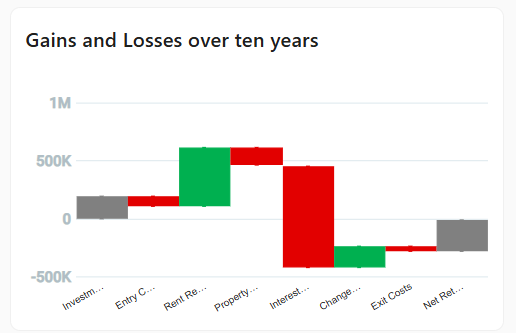
Note - this is NOT saying the property would decline in value. Just that your costs would swamp any gains.
Scenario sensitivity
| Variable | Effect |
|---|---|
| High real rent growth | Improves outcomes, may reach break-even with exceptional increases |
| Low rent growth | Increases losses |
| High mortgage rates | Severe equity erosion |
| Low mortgage rates | Significant upside through leverage |
| High wage & inflation growth | Eases serviceability constraints |
The conclusion is straightforward: leveraged property investment requires rents and wages to grow faster than interest costs, a condition not currently supported by macro data.
Cross-City Comparisons
Houses
- Sydney/Melbourne: mortgage-to-rent ~190–200%
- Brisbane/Adelaide: ~120–150%
- Perth: ~20% above rents, supported by high incomes and lower valuations
Units
- Sydney, Melbourne, and Perth sit near the 50th–60th percentile in affordability
- Brisbane and Adelaide units appear significantly stretched
The national theme is consistent: houses are more stretched than units, and Sydney remains the market with the least affordability headroom.
Critical Indicators for Forward-Looking Analysis
Three metrics carry the most weight for medium-term forecasting:
- Real wages — currently low; recovery would materially improve serviceability.
- Real rents — currently elevated; likely to revert without structural supply shortages.
- Mortgage rates — the dominant near-term lever; lower rates would restore substantial affordability.
In the absence of wage growth, meaningful affordability relief requires lower mortgage rates.
Conclusion: Key Takeaways for Market Interpretation
In reviewing the full spectrum of affordability indicators, the data points toward a market constrained primarily by interest rates and wages rather than supply-side frictions. The current environment reflects structural affordability limits, particularly for detached housing in major cities such as Sydney and Melbourne.
From an analytical perspective, the most important variables to monitor are real wages, rental growth relative to inflation, and mortgage-rate trajectories. These three factors will determine whether affordability improves through higher incomes, lower borrowing costs, or a reversion in rental inflation.
Until one of these levers shifts materially, Australia’s housing market is likely to remain defined by elevated debt servicing burdens, weakened purchasing incentives, and compressed investment returns. As such, affordability will continue to be the central constraint shaping pricing outcomes across the country.
Sources:
Nucleus Wealth has compiled this data using a range of different sources.
We use Domain for more recent data quarterly property prices and rents, cross-checked with SQM to fill any short-term moves. Older information is from Rismark and the Australian Bureau of Statistics to fill time series.
For economic data, we use either Reserve Bank of Australia or Australia Bureau of Statistics data. For older data, we have had to estimate some factors due to differing definitions over time.
Follow @DamienKlassen on Twitter or Linked In
The information on this blog contains general information and does not take into account your personal objectives, financial situation or needs. Past performance is not an indication of future performance. Damien Klassen is an authorised representative of Nucleus Wealth Management, a Corporate Authorised Representative of Nucleus Advice Pty Ltd - AFSL 515796.