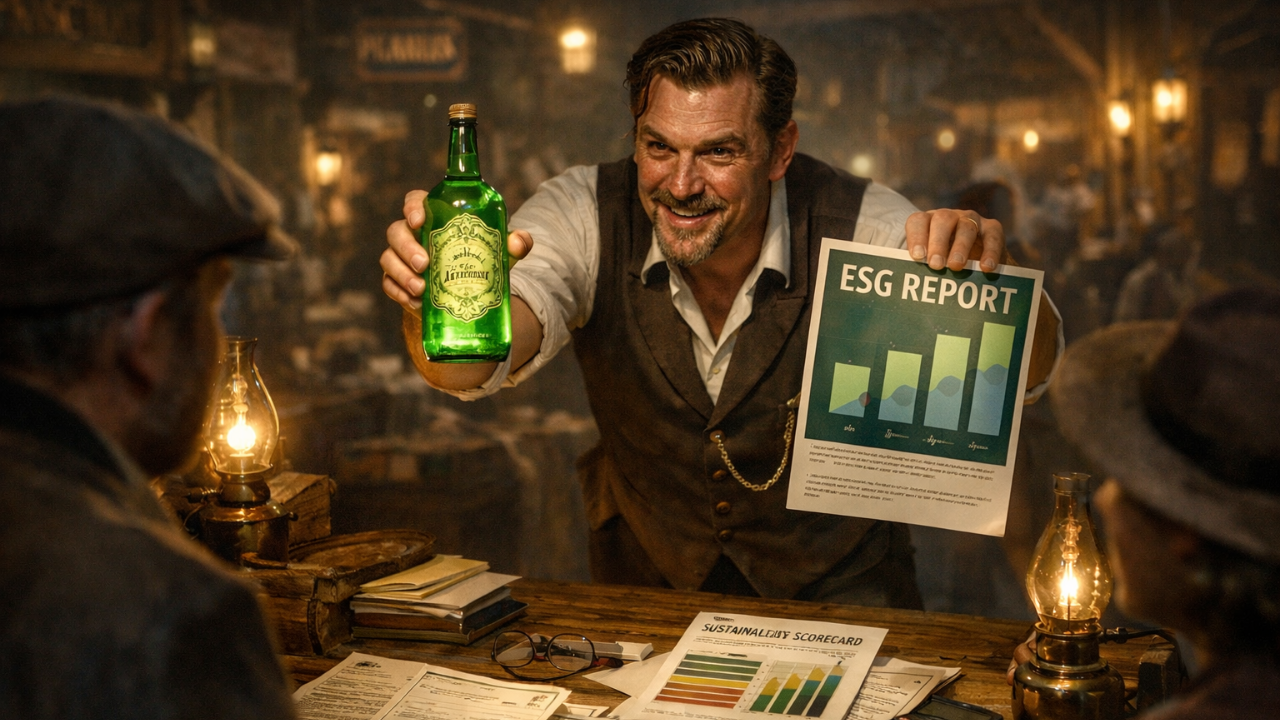
Quick disclaimer. I run ethical funds. We let clients add or subtract ethical (and investment) themes from all our portfolios. But I've never been a fan of the industry. Seven years ago, in a post titled Ethical Snake Oil, I argued that the booming industry of ESG (Environmental, Social, and Governance) ratings was more akin to marketing magic than investment medicine.
At the time, that was a contrarian view. The industry was selling the dream that you could save the world and outperform the market simultaneously, all by trusting a simple "score."
The data has finally caught up with the skepticism. The "Snake Oil" label wasn't just rhetorical; it was mathematically accurate. Here is why the "packaged ethics" model has broken down, and how you should actually handle ethical investing today.
1. The "Aggregate Confusion" Problem
In 2018, I highlighted a CLSA report showing that ESG raters couldn't agree on which stocks were good or bad. Since then, the evidence has moved from anecdotal to academic.
The gold standard for this is now the MIT Sloan "Aggregate Confusion" project. Researchers analysed the major ESG rating agencies and found that the correlation between their scores was only roughly 0.61.
To put that in perspective:
-
Credit Ratings (Moody’s vs S&P): 99% correlation. If one says a company is safe, the other likely agrees.
-
ESG Ratings: A coin toss.
You wouldn't buy a medicine if one doctor said it was a cure and another said it was poison. Yet, investors have been paying premium fees for funds based on "proprietary data" that is effectively random noise.
2. The Tesla Paradox
The absurdity of trying to mash E, S, and G into a single number peaked in May 2022.
That month, the S&P 500 ESG Index—perhaps the most followed ethical benchmark in the world—removed Tesla.
Let that sink in. The company, arguably doing more to decarbonise global transport than any other, was booted out of the "Environmental" index. At the same time, Exxon Mobil remained in the index.
Why? Because ESG scores are an average. Tesla scored high on "Environment" but was penalised on "Social" and "Governance" (labour codes, board conduct). Exxon, meanwhile, had great corporate governance and disclosure policies, which offset its business of drilling for oil.
As I wrote in 2018: “Most quantitative scoring systems have significant problems as soon as you start trying to combine different measurements.”
The Tesla moment was the wake-up call. It proved that these scores don't measure "impact"; they measure compliance with a checklist.
3. The Performance Penalty (The 2022 Reality Check)
For years, ESG funds claimed they could outperform the market. In reality, they were just overweight Technology and underweight Energy.
When Tech boomed, ESG looked like genius. But when Russia invaded Ukraine in 2022, the cycle turned. Defense and Energy stocks—the two sectors almost universally banned by ethical funds—became the market leaders.
If you invested in a generic ESG fund, you didn't just pay higher fees; you likely underperformed significantly during that rotation.
The net effect is that ESG portfolios don't outperform because they have better stock selection. Nor do they underperform because they have worse selection. My thoughts now are a little more nuanced:
- If you are investing in an active fund (and you think that active managers add value) then expect to give up performance. You are basically asking an active manager to outperform other active managers but allowing them to invest in fewer stocks.
- If you are investing in a passive fund (and added points if you think active managers don't add value) then it is a coin toss. You are just as likely to exclude a poor sector as a good one.
4. Regulators Call It "Greenwashing"
In 2018, I called it Snake Oil. Today, regulators call it "Greenwashing."
From the SEC in the US to ASIC in Australia and the EU regulators, there has been a massive crackdown on funds claiming to be "green" while holding the same old stocks. The marketing gloss has been stripped away, forcing funds to admit that their "ethical screening" was often little more than excluding tobacco and calling it a day.
So, what should you do now?
The conclusion I reached seven years ago remains true:
1. Stop outsourcing your conscience. No rating agency knows your values. Some investors hate nuclear power; others view it as the only solution to climate change. No single "score" can resolve that.
2. Use Direct Indexing or Customisation. Direct Indexing platforms allow you to hold a broad portfolio but apply your own filters. You can click a button to "Exclude Gambling" or "Exclude Fossil Fuels" without paying a fund manager 1% to do it for you.
3. Check the fees. (Still). The irony of "Ethical Funds" charging "Unethical Fees" hasn't changed. If you are paying a premium for an ESG ETF that just tracks the market minus three stocks, you are being taken for a ride.
The "Snake Oil" era is ending, replaced by a demand for transparency. Don't buy the label; buy the underlying assets that align with your view of the world.