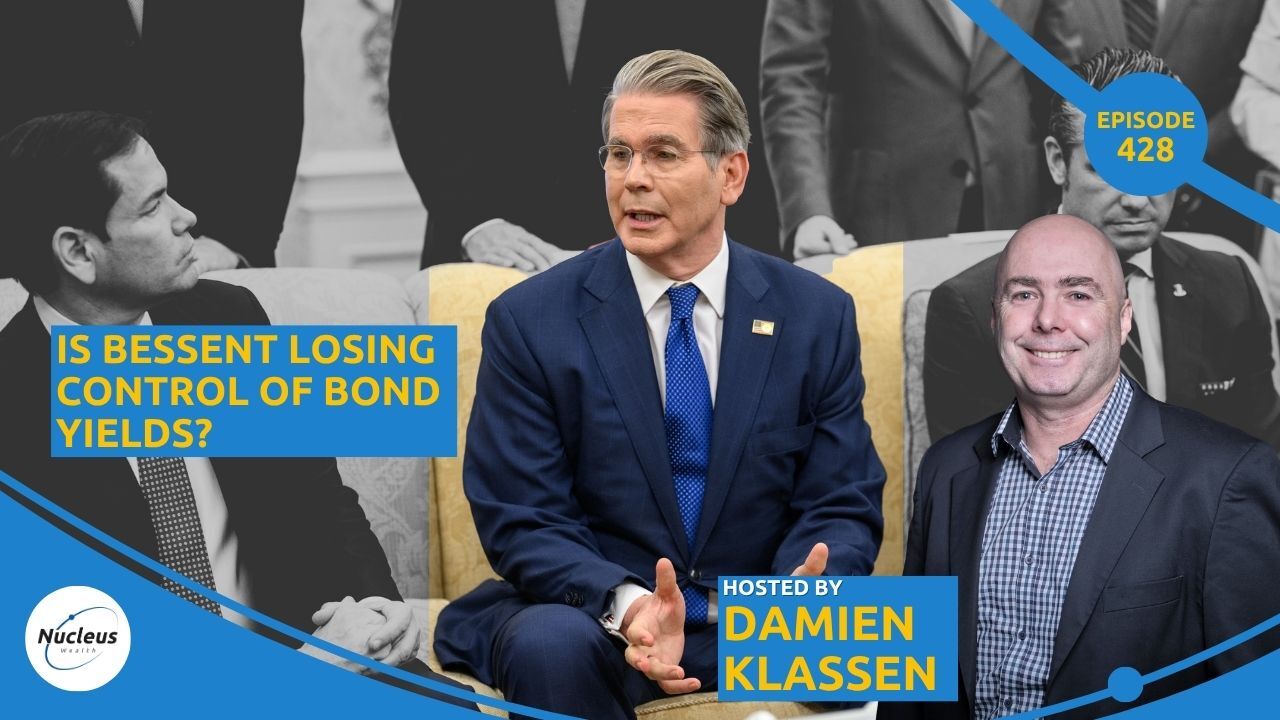
For much of the past six months, the direction of U.S. Treasury yields has been hard to ignore. The 10-year Treasury yield has climbed from around 4% to roughly 4.7%, briefly moving above that level. That has raised a broader question for investors: can U.S. Treasury Secretary Scott Bessent actually keep a lid on long-term borrowing costs?
At first glance, the recent move looks significant. But putting it into a longer-term perspective gives a more nuanced picture.
During the COVID-19 pandemic, the 10-year yield fell below 1% as central banks slashed interest rates and governments provided enormous fiscal support. The subsequent inflation shock triggered a historic bond sell-off, pushing the yield from around 1% to a peak close to 5% in 2023.
Since then, the 10-year yield has moved in a broad range of roughly 4% to 4.7%. The latest rise has been more persistent than some of the earlier moves associated with the beginning of the Trump presidency, but it is still part of a much larger adjustment in the bond market.
The fundamental problem for policymakers is straightforward: inflation remains relatively high and economic growth remains reasonably strong. Both factors create upward pressure on interest rates.
That makes Bessent's task considerably more difficult.
Bessent's attempt to push yields lower
The Treasury has announced plans to increase the amount of long-term Treasury bonds it buys back. The basic idea is relatively simple.
The Treasury can issue more short-term debt and use the proceeds to purchase some longer-term bonds, putting downward pressure on long term yields.
The approach is normally associated with the US central bank. But, the Treasury is attempting to influence the bond market at a time when the Federal Reserve has an almost opposite objective.
The Fed chair recently explained why higher long-term bond yields will help bring inflation under control. Not long after that statement, Bessent launched his plan to bring bond yields down.
The Trump administration, has an obvious preference for lower interest rates. Lower borrowing costs would support housing, investment and economic activity while reducing the government's cost of servicing its enormous debt burden.
This creates an uncomfortable tension.
Bessent has more direct political accountability to the president than the Federal Reserve does. But the Treasury cannot simply declare that interest rates should be lower and expect the bond market to comply.
The emergence of a "Bessent put"
This creates an interesting possibility for financial markets: the emergence of what could be called a "Bessent put."
The idea is that investors begin to believe that if Treasury yields rise too far or too quickly, the government will intervene.
That expectation could have consequences well beyond the bond market.
If investors believe that the Treasury will step in to prevent a disorderly rise in yields, they may become more comfortable taking risks elsewhere. Equity investors, for example, could increase their exposure or use more leverage because they believe the government will prevent the bond market from becoming too disruptive.
In that sense, reducing risk in one part of the financial system could simply shift it elsewhere.
There is also a question of credibility.
At some point, investors may deliberately test the Treasury's willingness to intervene. If yields continue rising despite repeated interventions, the market may conclude that Bessent's ability to control the long end of the curve is limited.
That would make the "Bessent put" considerably less powerful.
Why intervention can still work
Government intervention can influence the price of bonds at the margin, but it cannot permanently override the economic fundamentals behind those prices.
That does not mean Bessent's actions are pointless.
In fact, they may be particularly effective at preventing extreme moves.
Bond markets are heavily influenced by leveraged investors. If traders become convinced that yields can only move higher, they can build large positions betting against bonds. Those positions can become self-reinforcing: more selling pushes yields higher, which encourages more traders to join the trade.
Eventually, the market can move considerably further than the underlying fundamentals justify.
This is where government intervention can have an outsized impact.
If Bessent signals that the Treasury is willing to step into the market whenever yields rise too quickly, traders have to reconsider the supposedly one-way trade.
They may reduce their short positions, take profits or avoid adding leverage in the first place.
The result is not necessarily lower yields forever. The fundamental pressure may remain, but the speculative excess disappears.
What happens to other assets?
The implications extend across financial markets.
For equities, higher Treasury yields can be problematic because they increase the discount rate applied to future corporate earnings. If investors can earn a relatively attractive return from government bonds, they may also require a greater return from riskier assets such as shares.
Lower long-term yields, by contrast, can help support mortgage rates and other borrowing costs.
The U.S. dollar is more complicated. If Treasury intervention reduces the risk premium investors demand for U.S. debt, international investors could become marginally less enthusiastic about allocating capital to U.S. assets. That could place downward pressure on the dollar.
Gold and Bitcoin are another part of the story.
Both rose following the Treasury announcement as investors interpreted the intervention as another sign of potential fiscal or monetary debasement. There is also an important geopolitical dimension.
Recent combined US/Japanese currency interventions were presented in the context of currency stability. But, the Bessent intervention has many worried that it was always about the US bond market.
The concern is that the US Treasury seems to be undertaking increasingly unorthodox measures. These seem like crisis-level measures, without the crisis. Are they panicking?
What should investors watch?
The key question is not whether Bessent can temporarily move Treasury yields lower. He probably can.
The more important question is whether he can keep them there.
The longer-term outcome will depend on inflation, economic growth and fiscal conditions.
If inflation remains sticky, tariffs add to price pressures, oil prices rise, geopolitical tensions remain elevated and demand for artificial-intelligence infrastructure continues to support economic growth, there will still be fundamental reasons for investors to demand higher yields.
If those pressures fade, the Treasury's intervention becomes much easier to sustain.
For portfolios, this makes the issue an important watch point rather than an immediate crisis. I'm still favouring inflation-linked bonds, reflecting the view that real yields may ultimately be lower even if nominal yields remain elevated.
Ultimately, Bessent may be able to interrupt the momentum of the bond market. He may even be able to prevent some of its most extreme moves. But it is going to be really hard if the US central bank is working in the opposite direction.
The bigger question: Is this the start of a different challenge to the US central bank's independence? Trump has been rebuffed by the Supreme Court in his attempts to reduce the independence. Maybe this is just the first step in a strategy to reduce the overall power of the US Central Bank and increase the President's power to determine monetary policy.
This is a nascent risk. But worth watching.