

Beyond ETFs: Customizing Defence & Cybersecurity Exposure in Your Super

The global defence landscape is undergoing a structural shift. Escalating geopolitical friction, soaring national security budgets, and rapid technological adoption have pushed defence and technology stocks back into the core investment conversation.
For Australian investors managing a personal super sma australia or an SMSF, standard financial vehicles present a major hurdle. Conventional off-the-shelf Exchange Traded Funds (ETFs) enforce an all-or-nothing binary choice. You are forced to choose between buying a broad index that includes controversial weapons or completely excluding the sector and missing out on critical technological growth areas like cyber security and aerospace.
Modern portfolio construction requires a finer scalpel. By moving beyond pooled fund structures into direct indexing, retail investors can unbundle market benchmarks, apply custom ethical investment screening, and engineer tailored outcomes for their retirement savings.
The Problem with Pooled ETFs in a Changing World
Most sector-specific ETFs and broad passive indexes operate as rigid, opaque structures. When you purchase a standard global equities or technology ETF, you buy every constituent company within that index according to its market capitalisation, regardless of your personal ethics or risk tolerance.
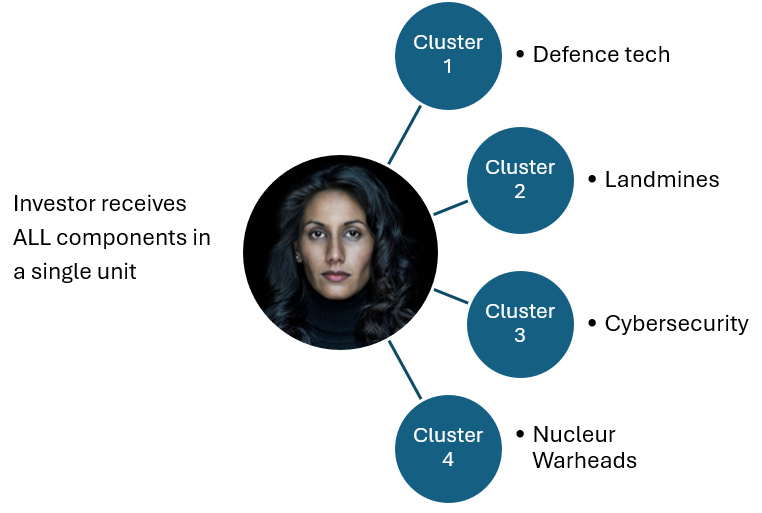
- Zero line-item control: Investors cannot remove individual stocks from a fund.
- Broad-brush exclusion risk: Standard ESG funds routinely ban all defence-adjacent stocks indiscriminately.
- Hidden exposures: General indices often bundle controversial weapons manufacturers alongside dual-use software providers.
- Costly overlap: Holding multiple legacy ETFs to capture specific sub-sectors creates unnecessary fee drag.
Direct Indexing vs. Legacy Funds: Structural Breakdown
Direct indexing solves this structural inefficiency by unbundling the index. Instead of owning units in a commingled trust, you hold beneficial ownership of the underlying individual shares. This architecture unlocks complete investment portfolio transparency and granular customization.
|
Feature |
Off-the-Shelf Pooled ETFs |
Direct Indexing & Personal Super SMAs |
|
Share Ownership |
Indirect (Units in a trust) |
Direct beneficial ownership of shares |
|
Negative Screening |
Fixed by fund manager |
Fully customizable stock-by-stock exclusions |
|
Positive Thematic Tilts |
Requires buying additional ETFs |
Integrated directly into a single portfolio |
|
Capital Gains Tax (CGT) |
Pooled CGT liability |
Isolated personal tax position per asset |
|
Portfolio Transparency |
Delayed or summary holdings |
Daily real-time visibility down to every share |
|
Management Costs |
Layered ETF fees |
Combined low fee wealth management Australia structure |
Granular Customization: Separating Defence Hardware from Cybersecurity
A primary advantage of a customizable superannuation fund powered by direct indexing is the ability to decouple defence contractors from defence technology.
Investors frequently want to exclude companies involved in cluster munitions, landmines, or weapons of mass destruction, while maintaining strategic exposure to modern defence infrastructure, satellite communications, and digital defence.
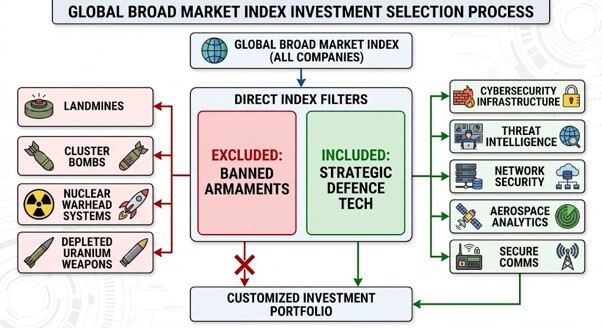
- Apply ethical screens: Strip out "worst offenders" and controversial armaments manufacturers automatically.
- Add specialized tilts: Target a dedicated cybersecurity investment portfolio or clean technology theme directly within the same core portfolio.
- Maintain core diversification: Re-weight remaining index constituents to match target asset allocation and minimize tracking error.
- Eliminate unnecessary turnover: Adjust filters dynamically as global risk profiles or personal preferences evolve.
Active vs. Passive: Managing Geopolitical Volatility
Purely passive index investing buys stock mechanically based on market cap, meaning you end up buying more of a stock after it has already surged in valuation. Conversely, active macro-overlay strategies dynamically manage risk based on business cycles, valuation metrics, and geopolitical shifts.
Combining the cost efficiencies of passive direct indexing with an active overlay delivers a robust hybrid approach:
- Rule-Based Passive Execution: Reduces base management fees and removes human behavioural bias from execution.
- Dynamic Risk Management: Utilizes defensive asset allocation shifts when macro headwinds increase.
- Tax-Smart Harvesting: Realizes tax losses systematically to offset capital gains across your superannuation account.
- Professional Grade Execution: Delivers institutional-grade portfolio execution for retail accounts, SMSFs, and personal super funds.
Implementing Tax-Smart Solutions in Your SMSF or Super
In addition to custom ethical screening, direct indexing offers structural tax advantages that legacy pooled funds cannot match.
TRADITIONAL ETF:

DIRECT INDEXING SMA:

- Isolate capital gains: Prevent tax liabilities triggered by other investors redeeming units in a shared fund.
- Individual cost bases: Maintain distinct tax lots for every share owned across global markets.
- Tax-loss harvesting: Offset gains in growing sectors by realizing losses in underperforming positions.
- Seamless transition for SMSFs: Transfer existing holdings into a single transparent platform without triggering immediate capital gains realization.
Take Control of Your Retirement Capital
Investors no longer need to accept blunt financial instruments that compromise either their ethics or their growth objectives. Through a customizable superannuation fund structure, you can construct a portfolio that actively reflects your values while maintaining exposure to critical defence and cybersecurity trends.
To explore how direct indexing, custom screening, and dynamic macro management can enhance your wealth strategy:
- Listen to the latest episode on the nucleus investment insights podcast for weekly macroeconomic updates.
- Review Damien Klassen's detailed market analysis and macroeconomic framework on our strategy portal.
- Explore our full range of tailored SMSF investment solutions and personal super SMA options.
Frequently Asked Questions
Can I exclude broad defence categories while keeping specific technology companies?
Yes. Unlike traditional off-the-shelf ETFs that bundle entire sectors together, direct indexing allows you to apply granular ethical investment screening. You can automatically exclude companies involved in controversial weapons or traditional armaments while maintaining targeted exposure to dual-use technologies, aerospace analytics, and cybersecurity.
How does direct indexing differ from buying a standard ESG ETF?
When you buy a standard ETF, you hold units in a commingled trust and must accept all underlying holdings chosen by the fund manager. With direct indexing on a transparent investment platform, you maintain beneficial ownership of the individual shares. This architecture gives you total line-item control to add custom tilts, exclude specific stocks, and isolate your own capital gains tax position.
Will applying custom defence screens significantly increase my management fees?
No. Advanced portfolio execution allows retail investors to access professional-grade investing for retail accounts at competitive rates. Because direct indexing removes the layered fees associated with stacking multiple niche ETFs, you benefit from low-fee wealth management in Australia while achieving tailored portfolio customization.
How does an active macro overlay help manage geopolitical risks in my super?
While direct indexing provides the cost efficiency and transparency of passive investing, an active management solution dynamically adjusts asset allocations based on global macroeconomic cycles and geopolitical headwinds. This hybrid approach helps protect capital during market volatility rather than passively tracking a benchmark down.
Can I transfer my existing SMSF portfolio into a customizable superannuation fund?
Yes. SMSF investment solutions powered by direct indexing allow for seamless portfolio transfers. Because you hold beneficial ownership of the underlying assets, positions can often be transitioned or rebalanced in a tax-smart manner without triggering unnecessary, immediate capital gains tax realizations.