
CoreWeave: a loose thread in the fabric of AI

CoreWeave’s debt problems raise a question that matters well beyond its shareholders:
Is Coreweave a loose thread that can be snapped with little damage? Or will it be the thread that unravels the entire fabric of the AI trade?
At the moment, I think it is more the former. And my expectation is that if CoreWeave went broke, its datacentres would keep on operating and its new projects would quickly find new owners.
But, there is enough uncertainty and importance to treat this as a critical issue for stock markets.
Big picture
I’m looking at the AI trade as critical to the stock market. AI capex is driving the profits of most of the global stock market, and its flow-on effects are holding up demand for most of the rest of the market. It really, really matters whether Coreweave is either:
- a financing problem at one company, or
- evidence that the economics behind the AI infrastructure boom do not stack up
That deserves even more attention because CoreWeave appears to be a capable operator. It has real customers, real infrastructure and a substantial business supplying computing capacity to the AI industry.
If an efficient operator cannot earn an adequate return from running GPU data centres, that would challenge a much larger investment thesis.
There is another issue for the broader market. Even if this is just a financing problem at one company, if the capital markets close up for AI financing because of it, then the boom is over.
Think of CoreWeave as a compute refinery.
A useful way to understand CoreWeave is analogous to a chemical or oil refinery:
- It takes an input commodity (electricity), outputs a different commodity (tokens/compute).
- It processes the inputs using expensive equipment it bought from someone else (NVIDIA mainly).
CoreWeave seems to be a high-quality operator. Operating efficiency seems in the top decile.
Refiners don’t have wide moats.
Coreweave is still just an operator of this refinery.
Its skills are in high demand right now, but you don’t pay top multiple for refiners.
The real value is captured by others in the supply chain.
The irony of CoreWeave’s low-risk “operating financing” structure.
This is going to sound weird, but stick with me. Ironically, CoreWeave’s financing at an operating level is lower risk than many of its competitors:
- CoreWeave gets a lot of money up front.
- Rather than selling at spot rates, CoreWeave typically gets a lot less per GPU/hour but locks clients in for 3-5years.
- This means CoreWeave has less asset/liability mismatch than many competitors. If GPUs last for five years and CoreWeave has locked in a rate for five years, then the hedging is really good.
The obvious question: if the financing structure at the operating level is so low risk, why is CoreWeave being priced as if it is going broke?
The answer is that CoreWeave has used its lower risk operating structure to leverage the crap out of the model.
For Australian investors, think AllCo or Babcock & Brown, who ran into the same problem with aircraft leases. It is smart to use debt for lower-risk operating structures. But if you add more corporate debt on top of that and then use your prepayments to fund the “equity” slice, the whole model gets hairy. Quickly.
CoreWeave’s background.
CoreWeave sells computing capacity. Customers use that capacity to train and run AI models.
Operating efficiency matters. So do the price customers will pay, the cost of the equipment and how frequently it must be replaced.
In the simplified business model used here, someone else builds the data centre shell. CoreWeave leases the premises, installs GPUs, networking and other infrastructure, and operates the facility.
There are two different investment horizons within that arrangement. A lease and much of the tenant infrastructure might last 15 years. The GPUs may need replacing every five years.
Over a 15-year facility life, the operator therefore needs to fund the original equipment and two subsequent refresh cycles.
That distinction is critical. A data centre can produce strong operating cash flow while still requiring substantial recurring capital expenditure. Treating all GPU spending as optional expansion would overstate what shareholders can ultimately take out.
The refinery analogy also helps frame valuation. Being an excellent operator has value, but it does not automatically justify the valuation multiple of a business that can grow with little additional capital.CoreWeave must keep investing in the equipment that generates its revenue.
Do the individual projects work?
To test the economics, consider a simplified 100-megawatt facility model using H100 GPU chips. The starting inputs are approximately:
| Assumption | Model input |
| Installed GPUs | 55,600 |
| Utilisation | 90% |
| Equipment investment | US$2.2 billion |
| Tenant infrastructure | US$300 million |
| Total initial investment | US$2.5 billion |
For the GPU economics, I use a starting rental revenue of US$3.25 per H100 GPU-hour.
The model assumes rental rates fall by 9% annually, other operating costs rise by 5%, and electricity and cooling costs rise by 3%.
Those assumptions deliberately put pressure on margins as the equipment ages. They represent a simplified earning curve, rather than the payment schedule of a particular customer contract.
After five years, the model replaces the GPUs and begins another operating cycle.
With 75% initial debt funding and a 9% borrowing cost, the facility produces a modelled equity internal rate of return of approximately 20%.
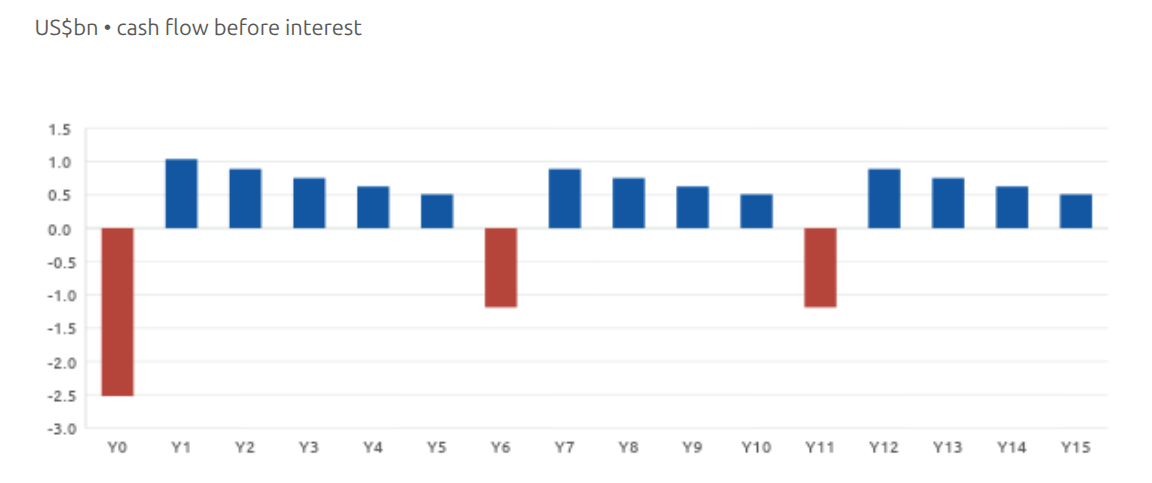
That is an attractive result. It is also a leveraged equity return, rather than an unlevered project return, and depends on the operating, financing and replacement assumptions holding.
The debt takes three years to pay off, the fourth year and fifth years are essentially all equity upside.
The conclusion I’m drawing is that nothing in CoreWeave's issues suggests problems with the economics of building a new data centre today.
That is a useful starting point, but it does not settle whether the company financing hundreds of these decisions is safe.
How good projects create a funding problem
The difficulty emerges when construction vintages are stacked on top of one another.
A completed facility can generate cash. A new facility requires money before it earns revenue. If the next construction programme is much larger than the existing operating base, cash generated by older facilities cannot cover the new investment.
CoreWeave had 420MW of data centres at the end of 2025, shortly before it listed. In the month of June 2026, it added 300MW! It is effectively building an entire new company every few months.
The table below shows the economic model that we put together, matched with the actual expansion that CoreWeave has done and is expected to do going forward. 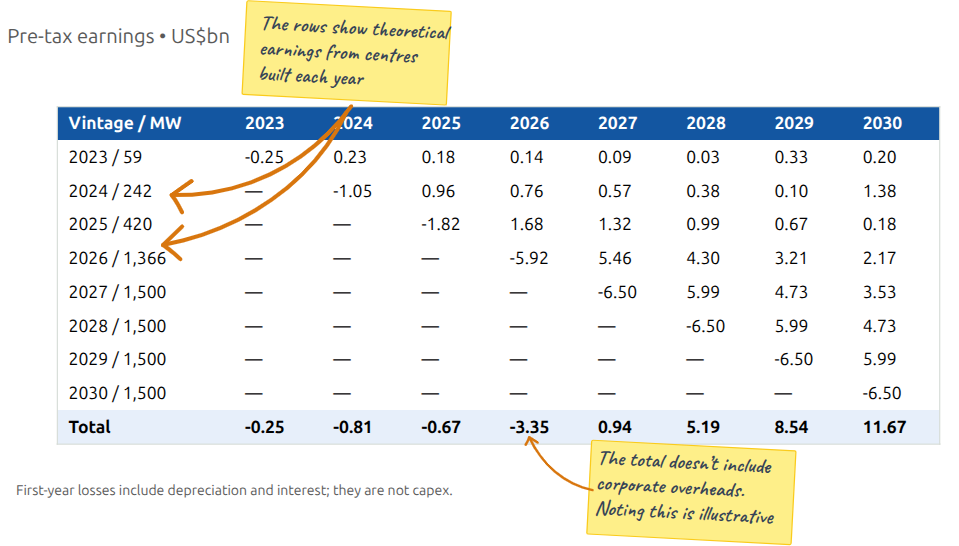
This explains how individually sensible projects can coexist with large losses and a persistent need for external capital.
It is important to distinguish those effects. Funding requirements also reflect equipment purchases, construction timing, customer receipts and debt repayments.
Also, the simplified model’s eventual profitability shouldn’t be mistaken for a precise company forecast. Corporate overheads, delivery dates and other costs can change the timing materially.
Eventually, the older operating base may become large enough to support a more sustainable business. But reaching that point requires continued access to funding—and ongoing GPU replacement spending does not disappear when expansion slows.
Lower operating risk can support higher financial risk
CoreWeave’s contracting approach helps explain why lenders have been willing to finance its growth.
A business borrowing against temporarily high spot prices is exposed if those prices collapse. Multi-year customer contracts reduce some of that uncertainty.
If equipment is expected to operate for around five years and has a substantial customer commitment covering much of that period, lenders have greater visibility over the receipts supporting their loans.
Customer prepayments can improve the funding position further.
The problem is what happens next. Greater revenue visibility allows more borrowing. More borrowing supports faster construction. Faster construction creates another large funding requirement.
A business with comparatively lower operating uncertainty can therefore become a very risky equity investment. Contracts reduce particular risks; they do not eliminate delivery problems, customer risk, refinancing requirements or obligations extending beyond the contract term.
Not every liability means the same thing
There is plenty of doomsday analysis for CoreWeave. Much of it is hyperbole.
CoreWeave already has substantial borrowing. There is no need to blur accounting categories to overstate the point.
Financial debt, lease liabilities, future commitments and customer advances all matter, but they represent different obligations.
A long lease secures access to a facility and commits the operator to future payments. A shorter lease offers more flexibility but introduces renewal risk. Neither arrangement can be understood simply by comparing the size of the recognised liability.
Customer advances require similar care. When a customer pays before receiving a service, cash increases and a deferred-revenue liability is created. The liability reflects work still owed to the customer.
That obligation is real. So is the financing benefit: the customer has supplied cash that would otherwise need to come from lenders or shareholders.
The cash may subsequently be spent on construction, so it cannot automatically be treated as money still available to offset the liability. Nevertheless, collecting cash upfront is not, by itself, evidence of financial deterioration.
The useful question is whether future receipts and funding sources can cover construction, service delivery, replacement equipment and financial obligations.
Why the equity outcomes are so extreme
How long will CoreWeave keep expanding before it stops? Keep in mind that its market cap is about $30-35 billion at the moment.
Let's look forward five years and assume that by that time, CoreWeave has stopped expanding and is now priced like a refiner. Ten times future earnings before interest and tax (EBIT) is a middle-of-the-road multiple for a refiner:
- If CoreWeave stopped today, their equity would be worth around US$7 billion (discounted).
- Continuing through 2028 (which it has contracts in place to do) produces roughly US$35 billion.
- Continuing through 2030 produces around US$74 billion.
These are scenario outputs, not price targets. They depend on reaching the assumed operating scale, funding the construction and achieving the modelled economics.
Changing the earnings multiple or rental price assumptions can dramatically affect equity value because debt absorbs a large share of operating value.
That cuts both ways.
A relatively modest change in assumptions sees the company as broke. Another relatively modest change sees the company worth 10x more than its current share price. Extreme leverage will do that.
Believing the data centres are useful does not mean the equity is attractive. Assets can continue operating under a different owner even if the original financing structure fails.
The broader risk is access to capital
My assessment is that CoreWeave’s troubles look more like aggressive financing meeting a less forgiving credit market than proof that GPU data-centre economics are fundamentally broken.
That does not put the AI investment boom beyond danger.
The scale of planned construction requires substantial external capital. If lenders and equity investors stop providing it, projects can be delayed, sold or cancelled even when their operating economics look reasonable.
A financing problem at one company could also undermine confidence in funding similar projects elsewhere.
For the operating economics, I continue to watch longer-term GPU rental rates. They provide a useful indication of what customers are willing to commit to paying for the equipment.
Token prices are harder to interpret in isolation: efficiency is improving while usage is expanding. Short-term, on-demand GPU prices can also be volatile. Longer-term rental commitments offer a clearer view of sustained demand.
For the wider investment cycle, the other indicator is whether capital remains available on workable terms. CoreWeave’s stress does not yet convince me that the underlying AI infrastructure economics have failed. It does show how vulnerable the build-out becomes when ambitious expansion depends on continued borrowing.
The projects can work, but financing can still bring the boom to a halt.