

Is an Ageing Population Really an Economic Burden?

I recently had a conversation with Cameron Murray about the economics of an ageing population, and some of his arguments challenged the way we usually think about demographics. The common narrative is that an older population means fewer workers, more retirees, and an increasingly unsustainable burden on government finances. Murray offered a different interpretation: perhaps the problem is not necessarily ageing itself, but how we measure its economic impact.
Here are some of the key points he raised.
Age dependency ratios don't tell the whole story
One of Murray’s central arguments was that traditional age-dependency ratios can give a misleading picture of economic dependency. These measures typically classify people over 65 as dependent and those aged 15 to 64 as working age, regardless of whether they actually work.
Murray pointed to changes in Australian employment patterns to illustrate the problem. In the late 1970s and early 1980s, around 40% of Australians aged 15 to 19 worked full-time. Today, that figure is below 10%. Meanwhile, the proportion of people aged 60 to 64 working full-time has roughly doubled, from around 20% to 40%.
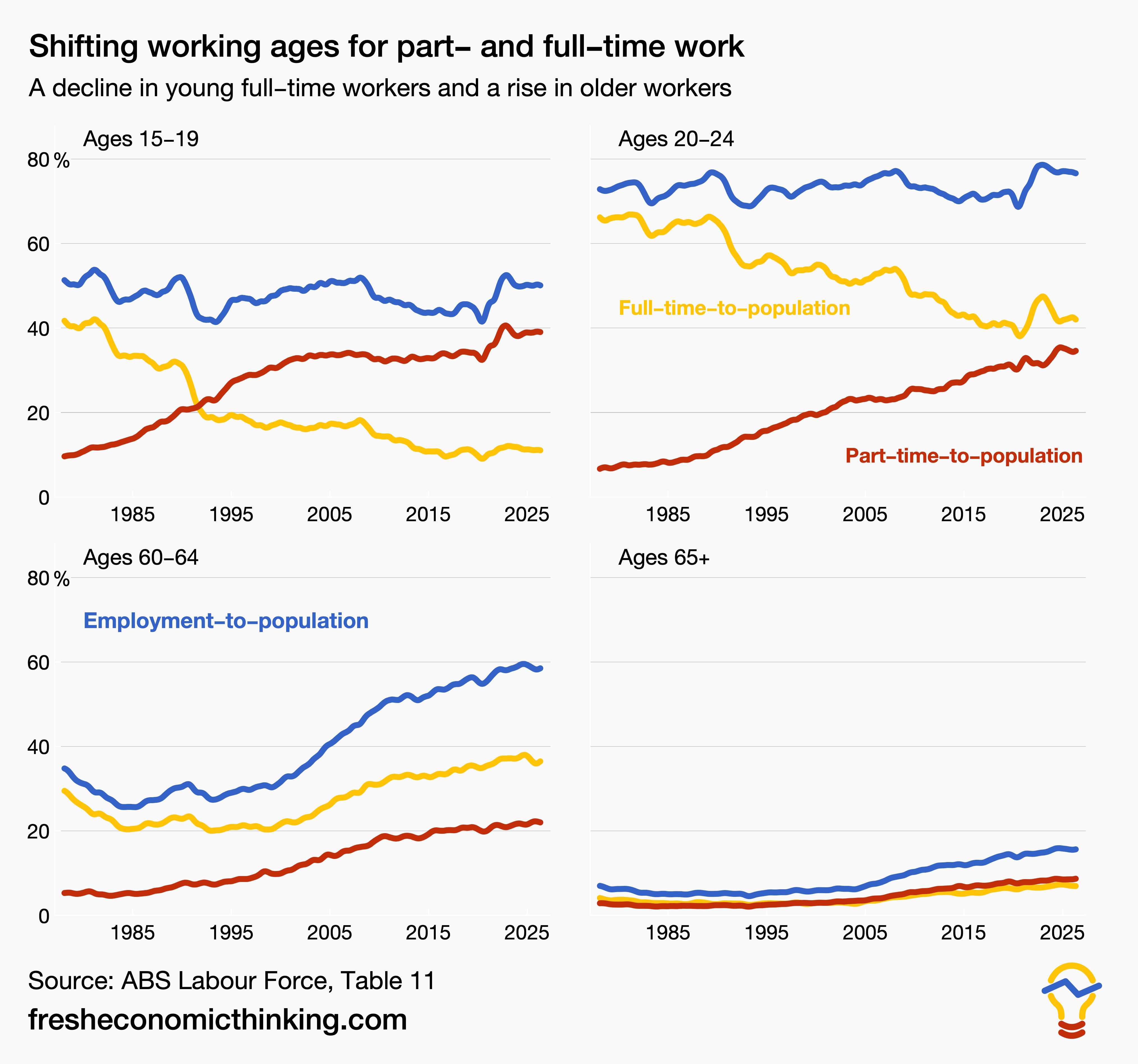
As Murray sees it, these figures expose a weakness in the conventional approach. Younger people are spending longer in education before entering full-time employment, while older people are increasingly remaining in the workforce. A fixed age threshold fails to capture these changes.
He argued that economic dependency, measured by whether people work rather than how old they are, offers a more useful perspective. In the country comparisons discussed, he noted that age-based dependency increased even as the proportion of the population not working declined.
Why ageing doesn't necessarily mean lower productivity
Murray also challenged the assumption that longer life expectancy must translate into a proportionate increase in dependency. He argued that people are generally remaining healthier for longer, potentially shifting the period of life when significant care needs emerge.
This does not mean healthcare and aged-care costs disappear. Rather, Murray suggested that increased spending on care should be understood partly as a change in what society consumes, rather than automatically as an economic loss. Resources spent on nurses and medical equipment, for example, might otherwise have been spent on travel or other services.
He extended this argument to productivity. In Murray’s view, labour shortages can encourage businesses to invest in machinery, automation and technology, allowing them to maintain production with fewer labour hours.
He cited examples ranging from hydraulic equipment in construction to robotic harvesting, restaurant self-service systems and automated ordering. Murray also referred to research suggesting that countries ageing more rapidly have, in some cases, experienced stronger productivity growth.
His argument was not that ageing guarantees productivity gains, but that demographic pressure can encourage businesses to adapt rather than simply constrain economic growth.
Murray's challenge to the superannuation argument
One of the more contentious parts of Murray’s argument concerned superannuation. He questioned the assumption that Australia's superannuation system necessarily solves the fiscal challenges associated with an ageing population.
His reasoning was that both pension recipients and retirees drawing on superannuation ultimately rely on goods and services produced by people who are working. Superannuation provides retirees with a financial claim on resources, but, as Murray argued, accumulating financial assets does not itself produce the goods and services people will need in retirement.
He also questioned whether the pension savings generated by superannuation justify the system's tax concessions. Murray argued that these concessions cost the budget more than the system saves in age-pension spending, potentially making pension funding more difficult rather than easier.
These are his assessments of the system's fiscal effects, rather than a claim that superannuation has no benefits. His broader point was that retirement financing should be evaluated in terms of how resources are produced and distributed, not simply how much wealth retirees have accumulated.
Japan and China challenge the demographic narrative
Murray pointed to Japan as an example of why ageing should not automatically be equated with economic decline. Despite a shrinking and ageing population, he argued, changes in employment, tourism and economic activity have helped reshape the country's economy.
China presents a different test of the same idea. Murray suggested that its modern industrial infrastructure, increasingly sophisticated machinery and potential for automation could moderate the economic effects of an ageing population.
Neither example proves that ageing is economically harmless. However, Murray's interpretation is that demographic trends alone cannot determine a country's economic future. How businesses, workers and governments respond matters just as much.
A different way to think about dependency
Across the discussion, Murray repeatedly returned to the distinction between demographic change and economic outcomes. An ageing population will alter consumption, labour supply and government spending, but he argued that these changes should not automatically be treated as evidence of an approaching economic crisis.
His preferred starting point is to look beyond the number of people above a certain age and consider how many people are working, what they produce and how the resulting resources are distributed.
That shifts the question from whether an ageing population is inherently a burden to whether the economy can adapt to meet its changing needs.
My Takeaways
When you look at it Cameron's way, even in countries with the worst demographics (Japan), the economic dependency is falling.
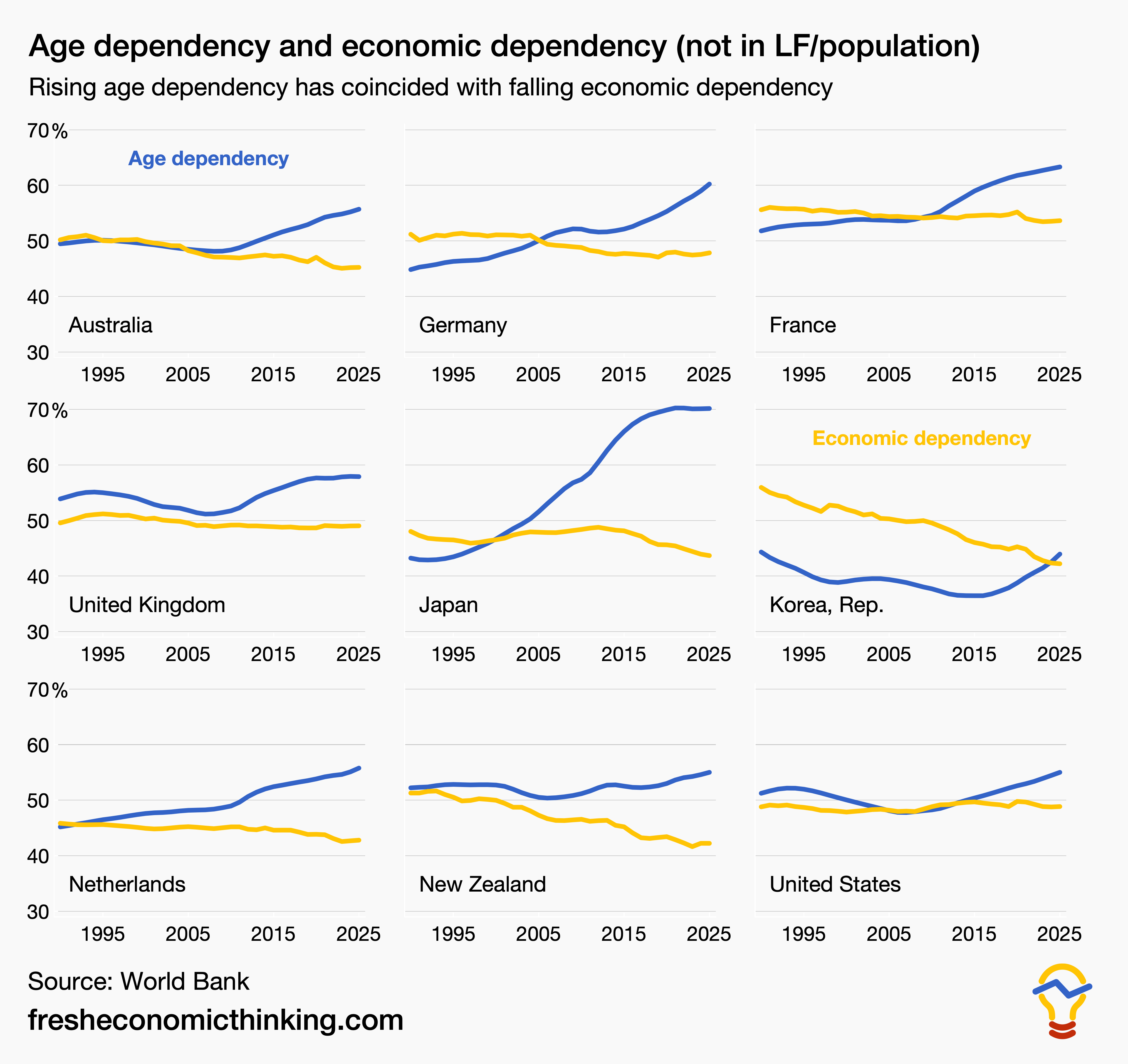
It is an indication that when better health allows people to work longer, they do.
Investment Impacts
Jeremy Grantham often talks about the demographic turning point in Japan when adult diapers started to outsell infant diapers. It is a stark microcosm that drives home the aging issues stemming from a worsening demographic profile.
Cameron's analysis does not invalidate the switch in investment from consumer goods for younger people to consumer goods for older people. But it does show people are clearly working much longer than they used to.
Maybe the moral of the investment story is less about a wholesale shift from goods and services catering to a largely retired population, and more about catering to the preferences of those who are still working deep into their sixties and seventies.
Take the financial services sector as an example. The trend to be less about servicing the mortgage market of young families and more about servicing the investment market continues. But maybe those older workers will continue to grow their savings long after conventional wisdom would have them drawing down.