
July 2026 Performance Report

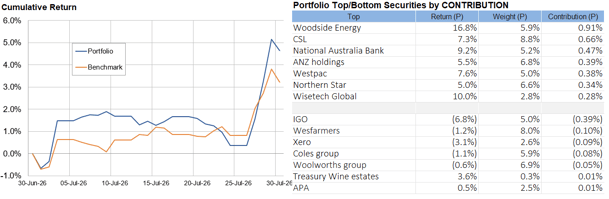
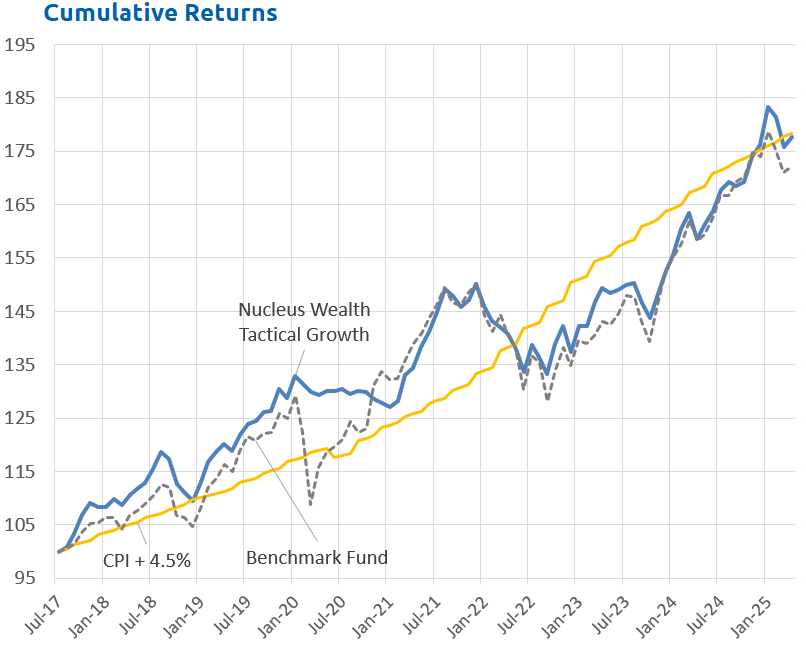
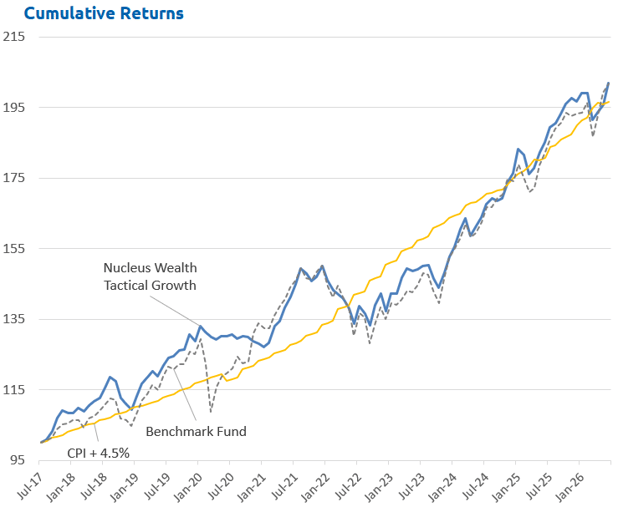
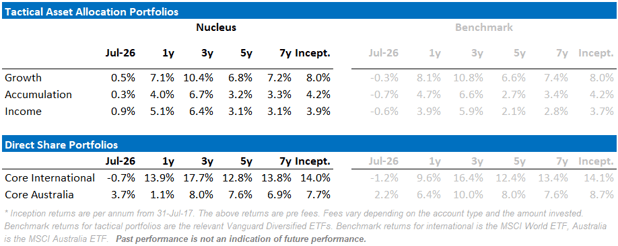
In July, the Australian dollar exposure was the main driver of returns as the heat came out of many of the booming semiconductor stocks. Our portfolios all outperformed their benchmarks significantly. Profit growth continues to be extraordinary. Stockmarket valuations are at the 80th percentile -i.e., expensive - but while profit growth remains some of the best ever seen, stock markets will have a hard time falling.
Rising inflation and interest rates are a key concern. And there are reasonable questions about the quality of the reported earnings. But the earnings growth remains extraordinary.
The Iran war is dominating headlines and asset allocation. The worst-case scenarios would be devastating for stock markets. But, given the strength of current earnings, any semi-reasonable resolution (or even an uneasy detente) will be positive for stock markets.
AI is booming. That doesn't make every AI stock a buy
Markets have had plenty of reasons to fall. Geopolitical shocks, stubborn inflation, higher bond yields and pockets of leverage are all capable of causing trouble. Yet the largest United States technology companies have kept producing the one thing that is difficult for investors to ignore: earnings.
There are signs of excess in artificial intelligence (AI), but there is also genuine demand, rapid revenue growth and substantial cash generation. Calling the whole sector a bubble is too simple. Buying anything with an AI connection is even worse.
A more useful analysis separates the businesses, examines who is funding whom and keeps watching the earnings.
One boom, several very different businesses
The AI trade is often discussed as though it were one investment. It is not.
At one end are the hyperscalers: companies such as Microsoft, Amazon and Alphabet. These businesses entered the boom with large established customer bases, strong balance sheets and enormous cash flows. Their cloud divisions are selling the computing capacity that companies need to build and run AI tools.
Their spending has become more aggressive. Businesses that investors once valued as capital-light software companies are pouring money into data centres, chips, power and associated infrastructure. In some cases, capital expenditure is absorbing most or all of the cash they generate.
That deserves scrutiny. But it is not automatically irrational. Revenue and profit from cloud and AI services have also been growing quickly. The uncomfortable truth is that a company can be spending an alarming amount of money and still be making a commercially sensible decision.
At another point in the chain are the suppliers. Nvidia and ASML have scarce technology and strong competitive positions. Memory-chip producers such as Micron, SK Hynix and Samsung are benefiting from powerful demand too, but their products are more exposed to commodity cycles. High current profits do not necessarily mean high-quality, durable earnings. These businesses have a history of over-investing when conditions are strong, creating too much capacity and driving the next downturn.
The distinction matters. Investors should not apply the same valuation framework to a platform with recurring revenue, a supplier with hard-to-replicate technology and a cyclical manufacturer enjoying unusually high margins.
The demand is real, but some of the financing is circular
The strongest case for the AI boom is straightforward: companies are paying for the technology because they expect it to save labour, improve output or create new products. Whether those expected savings are achieved will vary considerably between businesses.
If a business can replace a large recurring cost with a much smaller software bill, it may happily spend hundreds of thousands of dollars on AI services that did not exist in its budget two years ago. Multiply that decision across thousands of companies and the revenue opportunity becomes substantial.
The weaker part of the story sits among businesses that consume vast amounts of computing capacity while relying heavily on external capital. Some private AI developers can continue expanding while equity and debt markets are willing to provide funding. If that willingness fades, demand could slow quickly.
Circular financing makes the signal harder to read. When a chip supplier finances or guarantees a customer's data-centre capacity, and that customer uses the capacity to buy more of the supplier's chips, the order book no longer represents fully independent demand. The arrangement may work. It may even be necessary to build a new industry. But investors should recognise the similarity to vendor financing during the telecommunications boom: it looked self-reinforcing until capital markets turned.
The failure of one AI developer would not necessarily end the investment cycle. Its customers and computing capacity could move to a competitor. The greater risk is a broad loss of confidence that makes investors unwilling to fund the private companies at the centre of the ecosystem.
China may compress the economics
There is another reason to be selective. Chinese developers have released low-cost and open-source AI models that, in our assessment, are already capable enough for many tasks. They do not need to lead at the frontier to affect the economics of the industry. Even a model that trails the best systems but is available free or very cheaply can put pressure on prices.
China's manufacturing base may be even more consequential when AI moves into the physical world. Open-source vision and control software has reduced the cost and difficulty of building useful robots. Chinese manufacturers can combine that software with established supply chains and produce machines at price points that encourage experimentation by ordinary businesses, rather than only governments and large corporations.
This creates opportunity, but it may not accrue to the companies investors currently expect. Rapid adoption can coexist with falling unit prices and weak returns on capital. The technology can change the economy while disappointing shareholders in many of the companies that build it.
Higher bond yields change the calculation
AI investment does not occur in isolation. Data centres compete for capital, energy, water, construction materials and skilled labour. Heavy demand can create price pressure in particular inputs and regions, although productivity gains and falling computing costs may offset some of the broader inflationary effect. At the same time, large fiscal deficits and government debt issuance remain more direct influences on bond markets.
Higher long-term bond yields then raise the hurdle rate for every other investment. A future dollar of profit is worth less when discounted at a higher rate. Infrastructure, utilities and long-duration growth companies can all suffer, even when their underlying businesses remain sound. Investors may also demand more from equities when government bonds offer a better return.
Leverage makes sudden changes more dangerous. Momentum strategies, private credit structures and leveraged currency trades can look stable while prices move in the expected direction. When they reverse, forced selling can spread well beyond the asset that caused the initial problem.
None of this provides a reliable date for a market correction. It tells us where to look for fragility.
Why the decision is not all or nothing
The temptation in an uncertain market is to frame the choice as all or nothing. Either the AI boom is real and every related company must rise, or it is a bubble and cash is the only defensible position.
Both positions avoid the harder work.
There is always a convincing reason to stay out of markets, just as there is always a bullish story available somewhere. Waiting for every risk to disappear can leave an investor on the sidelines for years, while ignoring the risks can produce equally painful results. Diversification, deliberate position sizing and an explicit list of evidence that would challenge the thesis can reduce dependence on a single market-timing call. The appropriate exposure will differ between investors.
For the AI complex, earnings are central. Strong and broadening profits can justify continued investment despite high valuations and heavy spending. Deteriorating earnings, weaker returns on new capital, increasingly circular financing or a closure of private funding markets would be more serious warnings than dramatic headlines on their own.
The AI boom is real. So are the risks. Investors do not need to choose between blind enthusiasm and permanent pessimism. They need to distinguish durable cash flows from cyclical profits, independent demand from financed demand, and technological progress from shareholder returns.
That is less exciting than declaring a new era or predicting an imminent crash. It is also a better way to invest.
Asset allocation
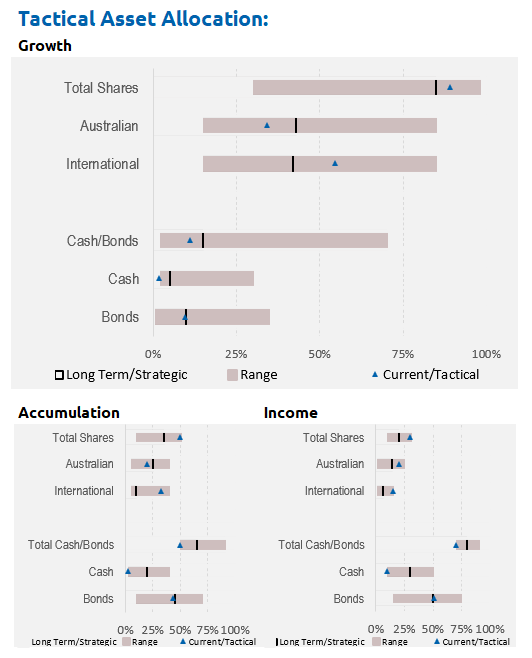
We have been winding back on our share exposure. We are overweight inflation-linked bonds. At the end of the month, the growth in international meant our allocation to shares was high:
Performance Detail
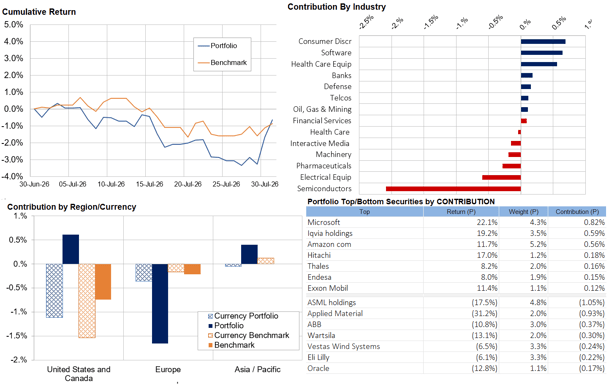
Core International Performance
Markets continued to drift south over July as global and upcoming earnings uncertainties loomed large. Performance was driven by a reversal in Semiconductors and Pharma stocks while Consumer Discretionary rebounded. Our overweight allocation to European equities is reflected in the regional return profile, yet despite a softer month there, the portfolio outperformed its benchmark overall. Currency was the major detractor as the AUD strengthened against all major currencies.
Core Australia Performance
Locally, stocks had another strong month, with Energy, Banks and a continued bounce in CSL driving performance. A late rally saw investors rebalancing portfolios into oversold domestic sectors, helping lift the broader index despite ongoing weakness in commodities.