
ATO Compliance and the Legal Reality of Crypto in Your SMSF

Cryptocurrency in a Self-Managed Super Fund (SMSF) gets plenty of headlines. Some trustees view digital assets as a high-growth speculative play. Others view them as an inflation hedge.
At Nucleus Wealth, we look at markets through a macro lens. We analyse liquidity, structural risk, and governance. When it comes to holding crypto in a superannuation environment, the biggest hurdle is not just market volatility. It is compliance.
The Australian Taxation Office (ATO) does not ban SMSFs from buying cryptocurrency. However, the regulatory framework is strict. One administrative misstep can breach superannuation law, trigger heavy penalties, or jeopardise your fund’s tax-concession status.
If you are evaluating digital assets alongside traditional equities, property, or fixed income in your SMSF superannuation strategy, you must understand the legal and operational landscape.
The Sole Purpose Test: The First Pillar of SMSF Compliance
Every investment made by an SMSF must satisfy the Sole Purpose Test under Section 62 of the Superannuation Industry (Supervision) Act 1993 (SIS Act).
The rule is straightforward:
- Your SMSF exists for the sole purpose of providing retirement benefits to members (or benefits to dependents upon death).
- Fund assets cannot provide a present-day financial or personal benefit to trustees or related parties.
Common Crypto Pitfalls
With traditional assets like Australian shares or managed funds, personal use is rarely an issue. Crypto is different. The boundary between personal and superannuation holdings is easily blurred.
Here are common scenarios that trigger immediate ATO breaches:
- Using Personal Wallets: Storing SMSF-owned crypto on a personal hardware wallet or personal exchange account.
- Using SMSF Crypto as Collateral: Staking or lending fund crypto to support personal loans or personal trading accounts.
- Personal Utility Benefits: Using SMSF crypto to pay for personal goods, services, or travel, even if you intend to reimburse the fund.
Key Takeaway: If an SMSF asset provides any direct or indirect personal utility, it fails the Sole Purpose Test.
Asset Separation: The "Strict Ownership" Requirement
Regulation 4.09A of the SIS Regulations requires trustees to keep fund assets strictly separate from personal assets.
When buying shares on the ASX, CHESS-sponsored accounts register the legal title directly to the fund trustee. Crypto exchanges do not work this way by default.
Requirements for Legal Title
To establish clear legal ownership under ATO guidelines:
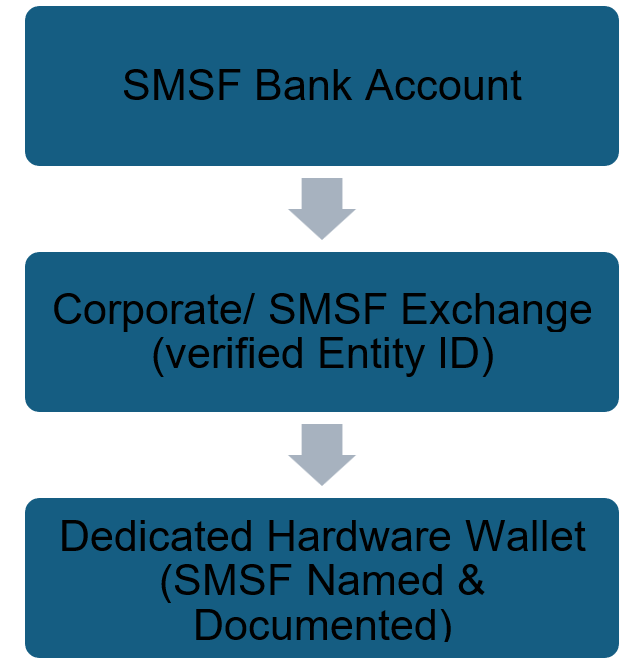
- Dedicated Entity Accounts: The exchange account must be opened in the name of the corporate trustee (or individual trustees as trustees for the SMSF). Never trade SMSF crypto on a personal trading account.
- Dedicated Wallet Infrastructure: If moving assets off exchanges into cold storage, the hardware wallet must be brand new, configured solely for the fund, and documented in the fund's asset register.
- Traceable Cash Flows: All fiat deposits and withdrawals must flow directly between the SMSF bank account and the verified SMSF exchange account.
Documenting Crypto in Your Written Investment Strategy
Regulation 4.09 of the SIS Regulations mandates that every SMSF maintain a written Investment Strategy.
You cannot simply buy Bitcoin or Ethereum on a whim and update your strategy later. The ATO expects trustees to document the rationale before placing a trade.
What the Investment Strategy Must Address
Your fund’s strategy must explicitly consider:
- Risk & Volatility: Documenting how high price volatility impacts the total portfolio value.
- Liquidity & Cash Flow: Ensuring the fund retains sufficient cash or liquid assets to pay annual tax liabilities, accounting fees, and member pensions.
- Diversification: Explaining why the fund holds digital assets and how they fit alongside traditional equity and fixed-income portfolios.
- Asset Allocation Ranges: Setting clear minimum and maximum percentage targets (e.g., 0% to 5% crypto allocation).
Operational Comparison: Traditional Assets vs. Crypto in an SMSF
Understanding compliance requirements becomes clearer when comparing crypto to traditional SMSF assets.
|
Governance Factor |
Australian Equities (ASX) |
Commercial / Residential Property |
Cryptocurrency (Digital Assets) |
|
Ownership Proof |
CHESS Holding Statement / HIN |
Land Titles Register |
Public Ledger Address & Exchange KYC |
|
In-Specie Transfers |
Permitted via Off-Market Transfer |
Permitted (Business Real Property only) |
Strictly Banned (Must be arm's-length cash buy) |
|
Valuation Source |
Closing Market Price (ASX) |
Independent Professional Valuation |
Reputable Exchange Rates at 30 June |
|
Auditor Verification |
Automated Bank & Registry Data |
Title Deed & Lease Agreements |
Blockchain Explorer & Public Keys |
|
Custody Risk |
Clearing House / Broker |
Physical Asset / Insured Building |
Exchange Insolvency / Key Loss |
Audit Trails and EOFY Valuation Requirements
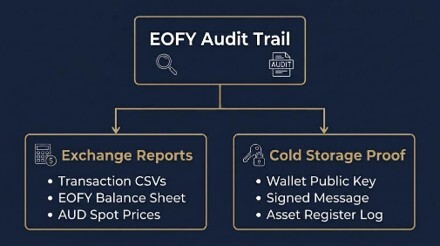
At the end of each financial year (EOFY), an approved SMSF auditor must review every transaction.
Auditing cryptocurrency is complex. Auditors must verify two main things:
- Ownership: Proof that the fund controlled the private keys on 30 June.
- Valuation: Proof of the market value in Australian dollars (AUD) as of 30 June.
Critical Audit Documentation Checklist
- Transaction Records: Complete logs of every buy, sell, swap, or transfer, including exchange fee breakdown.
- AUD Value Breakdown: Converting foreign currency (USD) or crypto-to-crypto pairs back to AUD using reputable spot rates at the exact time of the transaction.
- Public Key Verification: Providing wallet addresses to the auditor so they can independently check balances on the blockchain explorer as of 30 June.
- Signed Messages: Generating a cryptographic signed message from cold storage wallets to prove the trustee holds the private key.
Capital Gains Tax (CGT) & Tax Concessions
Cryptocurrency is treated as property for CGT purposes in Australia—it is not treated as foreign currency.
Every trade is a taxable event:
- Swapping Bitcoin for Ethereum triggers a CGT event.
- Selling crypto back to AUD triggers a CGT event.
- Using crypto to purchase another asset triggers a CGT event.
Note that if you trade it frequently, you might be classified differently and lose the discount.
SMSF Tax Advantages
Holding crypto inside an SMSF provides specific structural tax settings compared to personal ownership:
- Accumulation Phase: Capital gains on assets held longer than 12 months receive a one-third discount, lowering the effective CGT rate from 15% to 10%.
- Pension Phase: If the fund is in a tax-free pension phase, capital gains on supported assets may be exempt from tax altogether (subject to transfer balance caps).
Key Compliance Checkpoints
Before adding digital assets to your self-managed super fund, run through this compliance summary:
- Is the investment permitted under your fund's written trust deed?
- Has the Investment Strategy been updated to address crypto risk, liquidity, and diversification?
- Is the exchange account registered strictly to the SMSF?
- Are cold storage hardware wallets brand new and completely separated from personal devices?
- Do you have a process to capture transaction logs and AUD valuations for EOFY auditing?
- Does the fund retain enough liquid cash in AUD to cover tax liabilities and operating costs without forcing distressed crypto sales?
- Do you have succession planning? If the main keyholder dies or is incapacitated, can the assets still be accessed?
Managing an SMSF requires balancing growth opportunities with risk management, tax efficiency, and strict regulatory compliance. Exploring a tailored, low-cost structure for your broader portfolio can help keep your fund compliant and positioned for long-term growth. Learn more about how we manage institutional-grade, cost-effective superannuation by reviewing our Nucleus Wealth super options.
Changes are on the way
The Corporations Amendment (Digital Assets Framework) starts 9 April 2027, with a six-month transition. If you are choosing an exchange, use one that is AUSTRAC-registered now and is expected to hold an AFSL from 2027.
Should you use listed crypto ETFs instead?
These remove most of the custody, audit, valuation and related-party problems. There is a fee you pay, but for SMSF investors (far more than individual investors), paying that fee might avoid a host of compliance pitfalls.
What would investing with Nucleus look like if I want some listed crypto exposure in my SMSF?
Nucleus doesn’t buy, hold or advise on individual cryptocurrencies. What we can do is manage the core of your SMSF portfolio. We can also set your fund up so that a listed crypto ETF allocation sits alongside the core portfolio, cleanly separated and easy to audit.
A typical setup looks like this:
- A managed account for your core portfolio. It is opened in the name of your fund’s trustee, and Nucleus manages it. The account holds individually owned shares and ETFs. It is built from our core portfolios, and you can personalise it with screens and tilts.
- A separate self-directed account for crypto ETFs. It is also in the trustee’s name on the same platform. Your trustees decide whether to buy or sell a listed crypto ETF here, and how much. Those decisions remain yours.
- One set of records for your accountant and auditor. Both accounts produce holding statements, transaction histories and year-end tax reports. ETF units are valued at the 30 June closing price and appear on a registry, so there are no wallet addresses or signed messages to produce.
What changes compared with holding coins directly? You don’t manage private keys, so there’s no seed phrase to secure and no key-loss risk if a trustee dies or loses capacity. Valuation and ownership are verified the same way as for any other listed investment. ETFs can also be bought from a related party at market value, which isn’t possible with crypto itself. For example, you may be able to move units you already hold personally into the fund. Speak to your accountant first, because the transfer is a CGT event for you personally.
What doesn’t change? Your trust deed must allow the investment. Your investment strategy should set an allocation range for crypto exposure. The fund still pays CGT when it sells. Crypto ETFs carry the full price volatility of the underlying asset, plus a management fee. You hold units in a fund, not the coins themselves, so you can’t stake them or move them on-chain.
Frequently Asked Questions
1. Can an SMSF buy crypto directly from your personal wallet or trustee?
No. Transferring crypto from a related party into an SMSF (known as an in-specie contribution or transfer) is strictly prohibited under Section 66 of the SIS Act.
The fund must purchase all digital assets directly from an independent third party at arm’s length using cash from the fund’s dedicated bank account. Any off-market transfer between a trustee and the fund is an illegal transaction and will trigger an ATO audit finding.
2. What happens if I accidentally use my SMSF exchange account or wallet for personal trading?
Mixing personal and superannuation transactions breaches Regulation 4.09A (Separation of Assets) and Section 62 (Sole Purpose Test).
If an accidental trade occurs:
- Immediately quantify the transaction and document the exact date, price, and AUD value.
- Transfer the exact AUD equivalent back to the fund’s bank account.
- Notify your fund administrator or auditor before financial year-end to record the correction.
- Expect the auditor to lodge an Auditor Contravention Report (ACR) with the ATO if the breach is material.
3. Does staking crypto inside an SMSF violate superannuation regulations?
Staking is legally permissible, but it introduces specific compliance hurdles:
- Asset Separation: Staked assets must remain under the legal control of the SMSF trustee. Locking assets into decentralised protocols or unvetted smart contracts where ownership becomes ambiguous raises red flags.
- Taxation: Staking rewards are treated as ordinary income (taxed at 15% in accumulation phase) at the exact AUD market value on the day they are received, requiring rigorous transaction tracking.
- Liquidity Risk: Locked staking periods must not impede the fund’s ability to pay tax liabilities, auditor fees, or pension drawdowns.
4. How do SMSF auditors verify cold storage hardware wallets at 30 June?
Auditors cannot physically inspect a hardware USB device to prove balance ownership. Instead, they require cryptographic proof:
- Public Wallet Address: You must provide the wallet’s public address so the auditor can view the blockchain ledger balance on 30 June.
- Cryptographic Signed Message: Using wallet software (such as Ledger Live or Trezor Suite), you generate a unique digital signature using your private key to verify that the trustee—and only the trustee—controls the private keys.
- Purchase Receipts: Invoices proving the hardware wallet was purchased using SMSF funds.
5. Can an SMSF lose its tax-concession status over a crypto compliance breach?
Yes. If the ATO determines that an SMSF has committed serious or persistent compliance breaches, it can issue a Notice of Non-Compliance.
When a fund becomes non-compliant:
- The fund loses its 15% concessional tax rate.
- Its income and the market value of its total assets (minus net contributions) are taxed at the maximum individual marginal tax rate (currently 45%) for that financial year.
- Trustees may face personal administrative penalties that cannot be paid using SMSF assets.