
The AI Boom’s Next Big Risk

Nvidia has become more than just a semiconductor company. Its results have become one of the clearest indicators of whether the enormous investment boom in artificial intelligence is still gathering momentum.
That makes its latest results particularly important. So far, there is little evidence that the AI spending cycle is slowing. Revenue remains exceptionally strong, data-centre demand continues to grow, and the world’s largest technology companies are still committing enormous amounts of capital to AI infrastructure.
The more important question for investors, however, is whether the industry can continue adding capacity without eventually getting ahead of demand. The AI boom could remain highly profitable for some time, but the risks are increasingly shifting from shortages of chips and infrastructure towards the possibility of excess capacity and excessive financial leverage.
There will be an overbuild. But when?
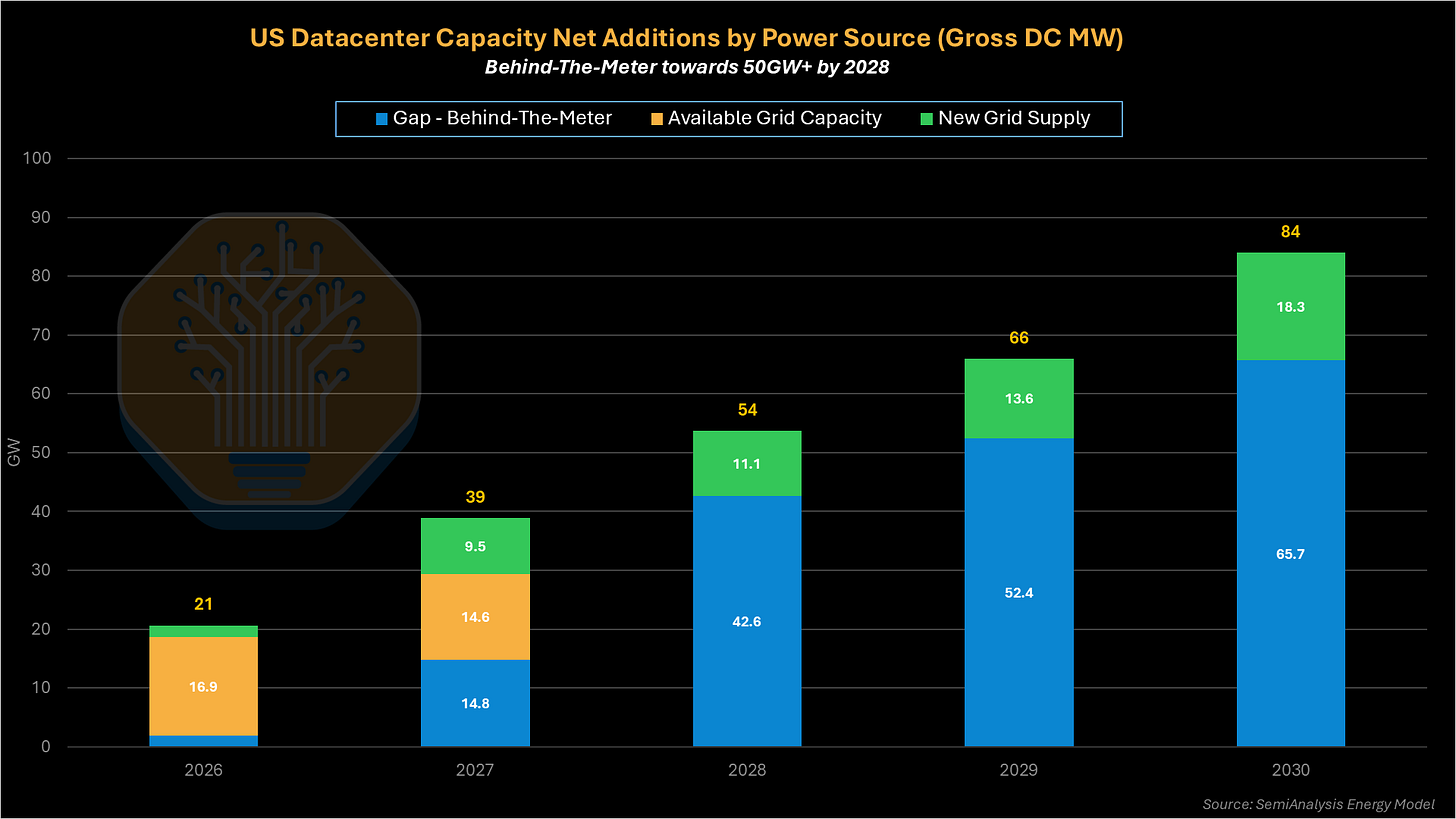
Every year for the next few years, it looks like data centre supply will at least double if you are measuring by power.
If you are measuring by tokens, its going to be more like 10x the capacity each year as the NVIDIA chips are more efficient with each generation.
The growth is extraordinary.
But, so are the economics. A1GW datacenter finished today will take a little over a year to get back your investment, at on-demand prices.
I can confidently tell you that there will be an overbuild at some point. But is that six months away or six years away? It is really, really difficult to tell.
The trillion dollar question:
Will there be enough AI tasks to use the capacity in a short period of time?
Will we find new ways to use the extraordinary increases in processing, or is there a relatively fixed group of users who are prepared to pay for AI. i.e. if capacity doubles, then suppliers will need to discount to fight over those users.
Let me use travel as an example
-
A year ago, Bob was exploring a European holiday with ChatGPT. Over a few hours Bob built up an itinery, looked at the options, the countries, the routes and planned his trip. Maybe that cost $1 in processing power.
-
In six months time, Mary is going through the same process. With better models, more efficient chips etc, maybe it costs $0.05 this time to plan. i.e. same outcome, fraction of the price.
- But, at the end of the process, Mary (or a company working for her) spins up an AI agent. It logs in into various websites, books accommodation, finds similar hotels on special and books those, resolves diary clashes with her partner and delivers a (mostly) booked holiday. Maybe that costs her $1 in processing power.
How many of those tasks are out there? How many are quickly deliverable? The growth is so extreme that no one can tell.
Nvidia remains at the centre of the AI investment boom
Nvidia sits at the practical epicentre of the AI infrastructure buildout. Its chips are required to train and run increasingly sophisticated AI models, meaning its results provide an early indication of spending on data centres, semiconductors, electricity and related infrastructure. Maybe 50-70% of the cost of a datacenter ends up in NVIDIAs pocket.
The important thing is not simply whether Nvidia beats earnings expectations. It is whether the AI boom is successfully moving through a series of bottlenecks, beginning with semiconductor supply and data-centre availability, followed by electricity, financing and, ultimately, demand for economically valuable AI computing.
Right now, the evidence remains overwhelmingly positive.
Broadening customers is a two edged sword
Nvidia's revenue doubled, with data-centre revenue accounting for more than 90% of the total. Margins were healthy and demand was broadening beyond the handful of hyperscalers that initially drove the AI spending boom.
That diversification is encouraging because Nvidia is becoming less dependent on a small number of enormous customers.
However, some of the specialised AI-cloud companies buying Nvidia's hardware are financially weaker or loss-making.
A broader customer base does not necessarily mean a stronger customer base.
The amount of infrastructure being built is enormous
The most striking part of the AI story may be the scale of investment still coming.
Spending by the five largest hyperscalers was described as rising from roughly $800 billion in the current year to $1.3 trillion the following year. Investment is also spreading beyond these companies, with specialised AI-cloud providers and enterprises expanding their own capacity.
At the same time, physical AI infrastructure is growing rapidly.
Existing modern AI-oriented data-centre capacity was estimated at roughly 10–15 gigawatts, while around 21 gigawatts of additional capacity was expected to be added in 2026. That could then double again in 2027, followed by further large additions.
This creates an important tension. Continued investment is evidence of strong expectations for AI demand, but it also increases the amount of capacity that will eventually need to generate an adequate return.
The concern is therefore not whether capacity is increasing. It is whether the industry eventually expands capacity faster than customers can profitably use it.
Electricity is a constraint, but technology is making it less restrictive
Electricity is often presented as the major physical limitation on AI expansion, and it remains an important constraint. However, data-centre operators are increasingly finding ways around traditional grid limitations by arranging their own power generation or combining behind-the-meter generation with new grid connections.
There is also an important technological development working in the other direction: newer AI chips are dramatically more efficient.
The latest systems can produce 10–20 times more tokens per unit of power, while a new data centre could potentially produce 30–40 times more tokens from the same power input compared with a facility built only two or three years earlier.
This means the supply of AI computing will increase much faster than the physical footprint of data centres suggests. More electricity can be brought online while improvements in chip efficiency allow that electricity to generate substantially more computing power.
For investors, that makes physical measures such as gigawatts less useful on their own when assessing whether the industry is approaching saturation.
The economics look fantastic, for now
At current prices, the economics of AI infrastructure appear extraordinarily attractive.
Construction costs are roughly $50–60 billion per gigawatt of data-centre capacity.
Yet potential annual revenue varies dramatically depending on how that computing capacity is sold. A long-term lease to a specialised AI cloud might generate around $12 billion per year, while renting Nvidia systems on demand could generate close to $30 billion. Some recent infrastructure agreements imply even higher revenues, while direct sales of inference capacity suggest around $100 billion of revenue per gigawatt.
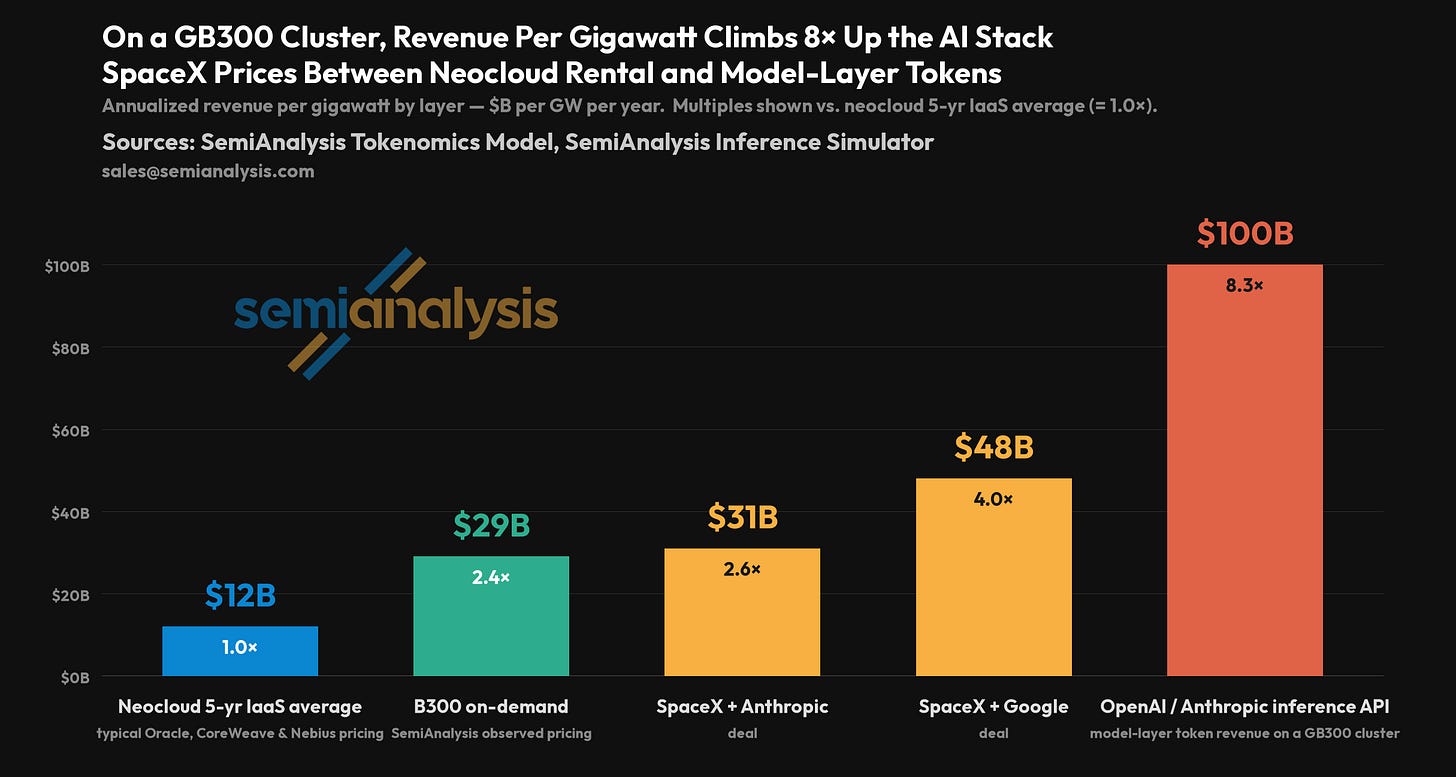
Those economics help explain why companies are rushing to build more capacity.
However, they also demonstrate why investors need to be careful about extrapolating today's returns indefinitely. If supply expands and customers gain bargaining power, revenue per unit of capacity could fall substantially. The analysis suggests that revenue could potentially decline from around $100 billion toward $12 billion per gigawatt.
Construction costs, meanwhile, do not fall nearly as quickly. A business that looks exceptionally profitable at today's prices can therefore become considerably less attractive if computing capacity becomes abundant.
Supply versus useful demand
This is why simply counting data centres or gigawatts does not tell us when the AI boom might peak.
What matters is the relationship between the amount of economically valuable computing that can be produced and the amount of computing that customers are actually willing to purchase.
The bearish case is that supply is expanding faster than demand. More data centres are being built, more chips are being packed into each rack, new chips are producing more tokens per megawatt and the cost of generating those tokens is falling. If customers cannot find enough profitable applications for the additional computing power, rental prices and utilisation rates could decline.
And the bear case doesn't need to be that we won't use the supply ever, just that the supply will appear before the demand uses are ready.
Jevon's paradox
The bullish case is that cheaper AI will create entirely new sources of demand.
Agentic AI is an important example. An AI agent capable of searching websites, comparing products, making bookings, managing connections and monitoring changes could require vastly more computing than a user asking a chatbot a single question.
This also relates to the Jevons paradox, where making a resource cheaper can increase total consumption rather than reduce it.
If an AI task becomes sufficiently cheap, applications that were previously uneconomic may suddenly become worthwhile, potentially generating enough new demand to absorb the additional capacity.
The bigger risk may be financing
There is another part of the AI boom that deserves increasing attention: how the infrastructure is being financed.
AI-related debt financing is already enormous. The concern is not necessarily that today's assets are uneconomic. At current prices, many appear highly profitable. The concern is what happens if revenues fall while debt, leases and other obligations remain fixed.
Equity-funded infrastructure can lose value without necessarily causing its owners to fail. Debt-funded infrastructure is different. If cash flows stop covering interest and lease payments, companies can fail, lenders can suffer losses and forced asset sales can push asset prices lower.
Nvidia is also becoming increasingly connected to this financing ecosystem. Some arrangements effectively allow Nvidia to support customers who purchase its chips, helping create the financing or revenue expectations that allow those customers to expand further. That expansion can then generate revenue that supports additional chip purchases and infrastructure investment.
These arrangements are pro-cyclical. They accelerate growth during an expansion, but will increase the consequences of a downturn.
What should investors watch?
The latest Nvidia results do not provide any signal that the AI boom is ending. Demand remains strong, capital expenditure continues to rise and Nvidia's profitability remains impressive.
There are plenty of red flags in debt and finance structures. But it seems really early in the cycle. If you are getting 100% growth, then finance structures aren't important. When growth slows to single digits, that's when the chickens come home to roost.
The warning signs are likely to appear elsewhere first.
Investors should watch for falling GPU rental prices, lower utilisation rates, weaker customer contract terms and declining residual values for used chips. Slower cloud revenue growth while capital expenditure remains high would also be concerning, as would increasingly generous vendor financing.
Token pricing is probably not useful on its own. A 90% fall in token costs combined with a 20x increase in the number of tokens used is an acceptable trade-off.
The nature of the risk is changing. The early stages of the AI boom were largely about whether companies could build enough infrastructure to satisfy demand. As capacity expands and technology makes each unit of infrastructure increasingly productive, investors will need to pay greater attention to whether the industry is building more computing power than customers can profitably use.
The investment discipline is therefore not to try to predict the precise moment the AI boom peaks.
It is to monitor the underlying economics. As long as demand, utilisation, pricing and profits remain strong, the boom can continue for considerably longer. If those measures begin deteriorating while infrastructure spending remains elevated and financing support becomes increasingly important, investors will have much clearer evidence that the industry's biggest constraint has shifted from insufficient capacity to excess capacity.