
The Market Is Cheaper Than It Looks, But AI Still Has Something to Prove

I’ve spent a lot of time looking at whether markets are getting ahead of themselves on AI. It’s a reasonable question given the scale of investment, the lofty expectations surrounding some of the biggest technology companies and the amount of capital flowing into data centres. But when you look beyond the headlines, the valuation picture is more nuanced than it first appears.
Markets aren't necessarily expensive across the board. In fact, several parts of the market look relatively cheap compared with their historical averages, even as earnings expectations remain unusually strong. The bigger question is whether those earnings expectations can be delivered, and how much of the current AI boom ultimately translates into sustainable profits.
That distinction matters. Strong earnings growth can justify higher share prices, but expectations can also get ahead of reality. And while AI continues to drive investment, there are several ways the cycle could unfold differently from what investors currently anticipate.
US Equity and AI Stock Valuations Are More Reasonable Than Headlines Suggest
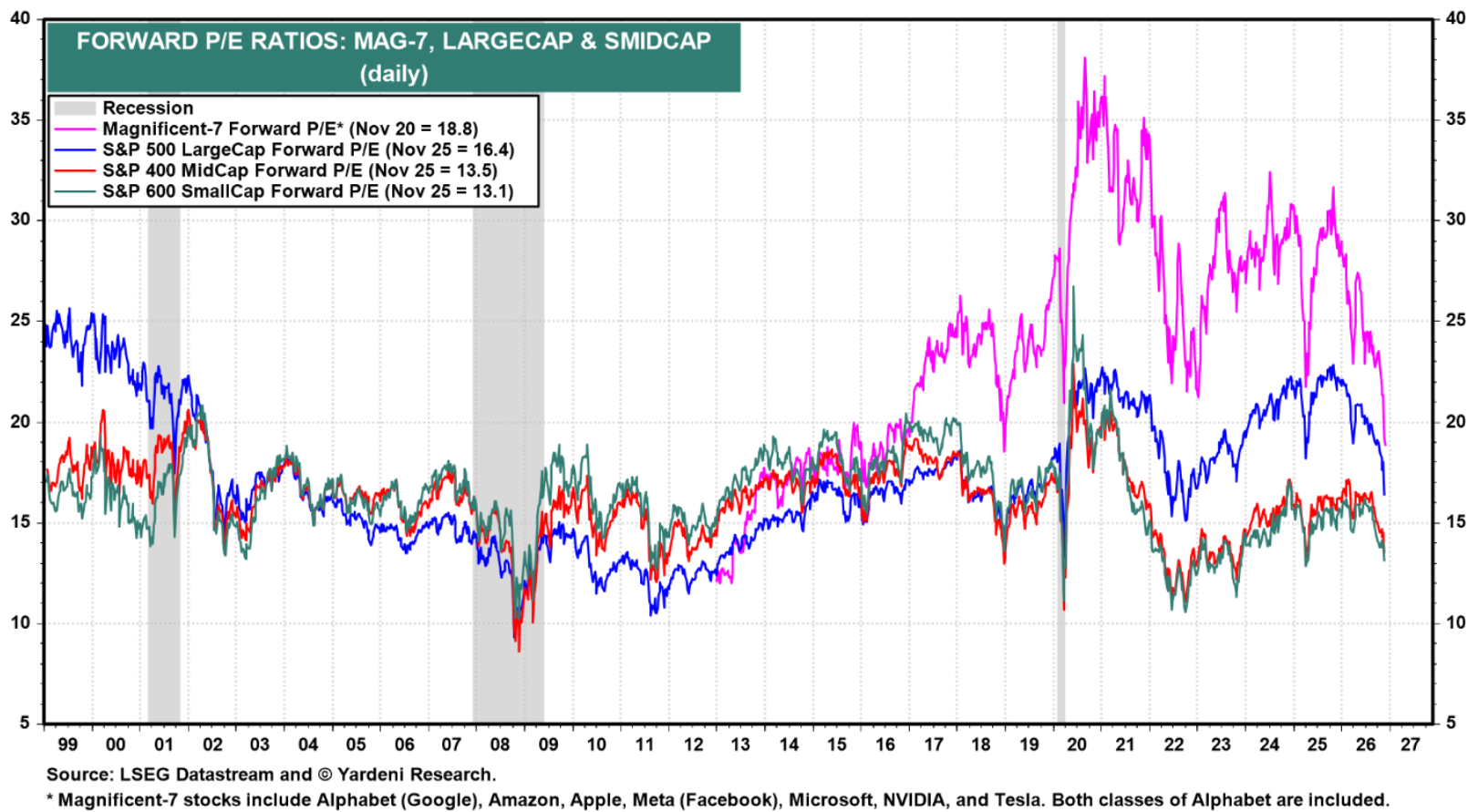
The valuation picture across US equities is not as stretched as the market's recent performance might suggest. US small- and mid-cap stocks are trading at roughly 13 times earnings, levels that sit below much of their historical range over the past 30 years. Large-cap stocks are also relatively inexpensive, with forward price-to-earnings ratios around 16 times, below their long-term averages.
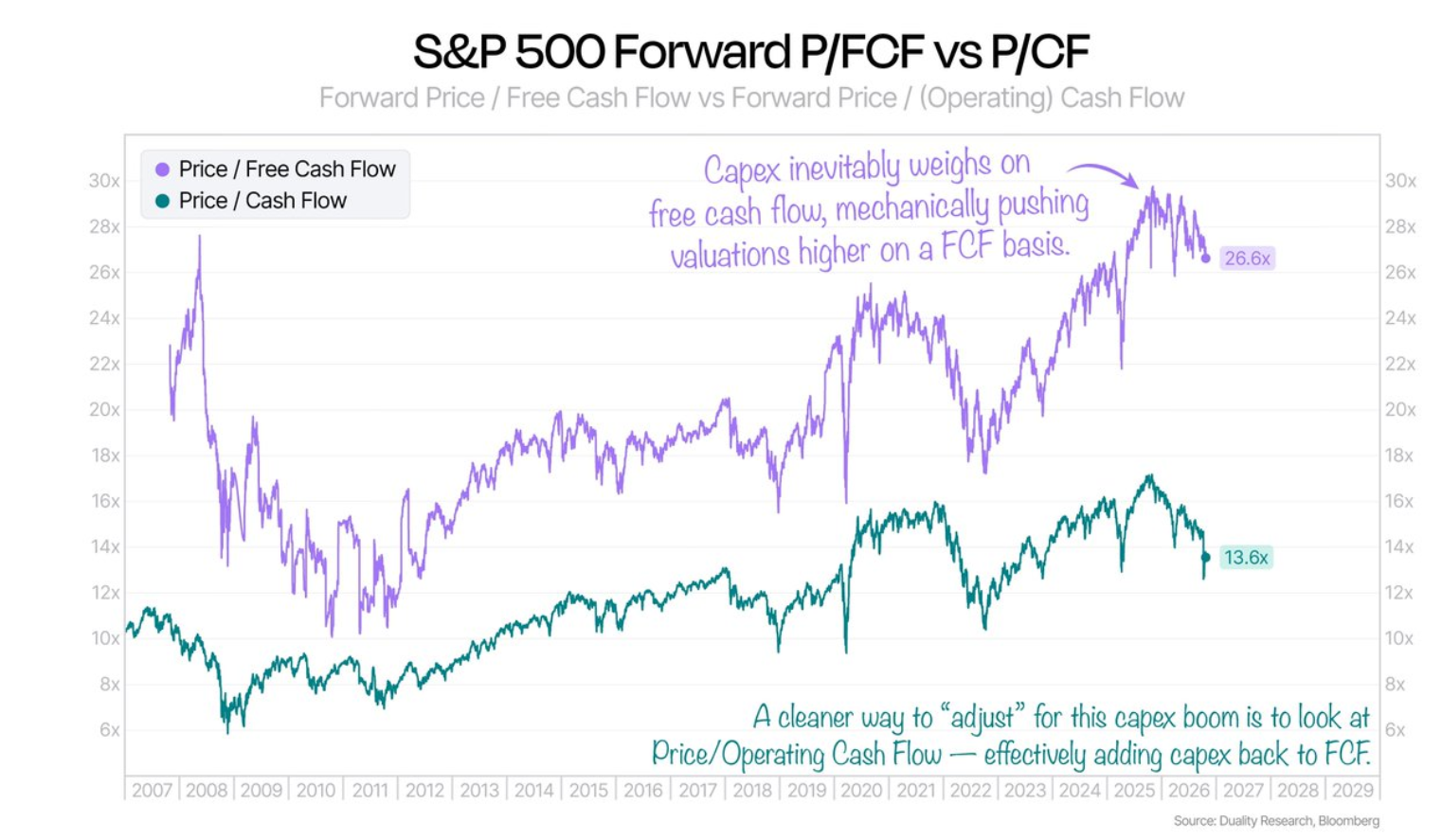
That doesn't mean every valuation measure is sending the same signal. Price-to-operating-cash-flow ratios are around 13.6 times, suggesting a reasonable entry point rather than a bargain. Free cash flow valuations, however, remain relatively expensive compared with much of their longer-term history, although they have eased from the levels seen over the past two years.
This is where the debate becomes more complicated. Earnings and cash flow measure different aspects of a business, and free cash flow can be heavily influenced by how capital expenditure is classified. Spending required to maintain existing operations is fundamentally different from spending designed to expand capacity and generate new revenue.
For AI companies, that distinction is particularly important. Building new data centres to serve additional customers may be expansionary investment, while spending to maintain existing infrastructure may be closer to required expenditure. Treating all capital expenditure equally can distort how investors assess a company's underlying cash-generating ability.
The Magnificent 7 also complicate the broader picture. These companies represent roughly 40% of the index, meaning their valuations have an outsized influence on headline market measures. Meanwhile, private companies such as OpenAI, Anthropic and SpaceX aren't included in the traditional index valuations, despite playing an increasingly important role in the broader AI investment ecosystem.
2026–2027 Earnings Growth Forecasts Remain Unusually Strong
Valuations are only part of the equation. What makes the current market particularly interesting is the strength of earnings expectations.
Analyst forecasts typically start out optimistic and gradually decline as the year progresses and companies provide more information. Earnings growth expectations often settle somewhere around 5–10%, even when initial estimates are considerably higher.
This time, the forecasts are much more ambitious. Earnings growth for 2026 is estimated at roughly 35%, followed by around 18% in 2027. Those figures are unusually strong outside periods of major economic recovery or significant policy changes.
More encouragingly, forecasts for 2027 have been trending upwards rather than following the usual pattern of downward revisions. That doesn't guarantee the earnings will materialise, but it suggests analysts are becoming more confident about the outlook rather than gradually tempering their expectations.
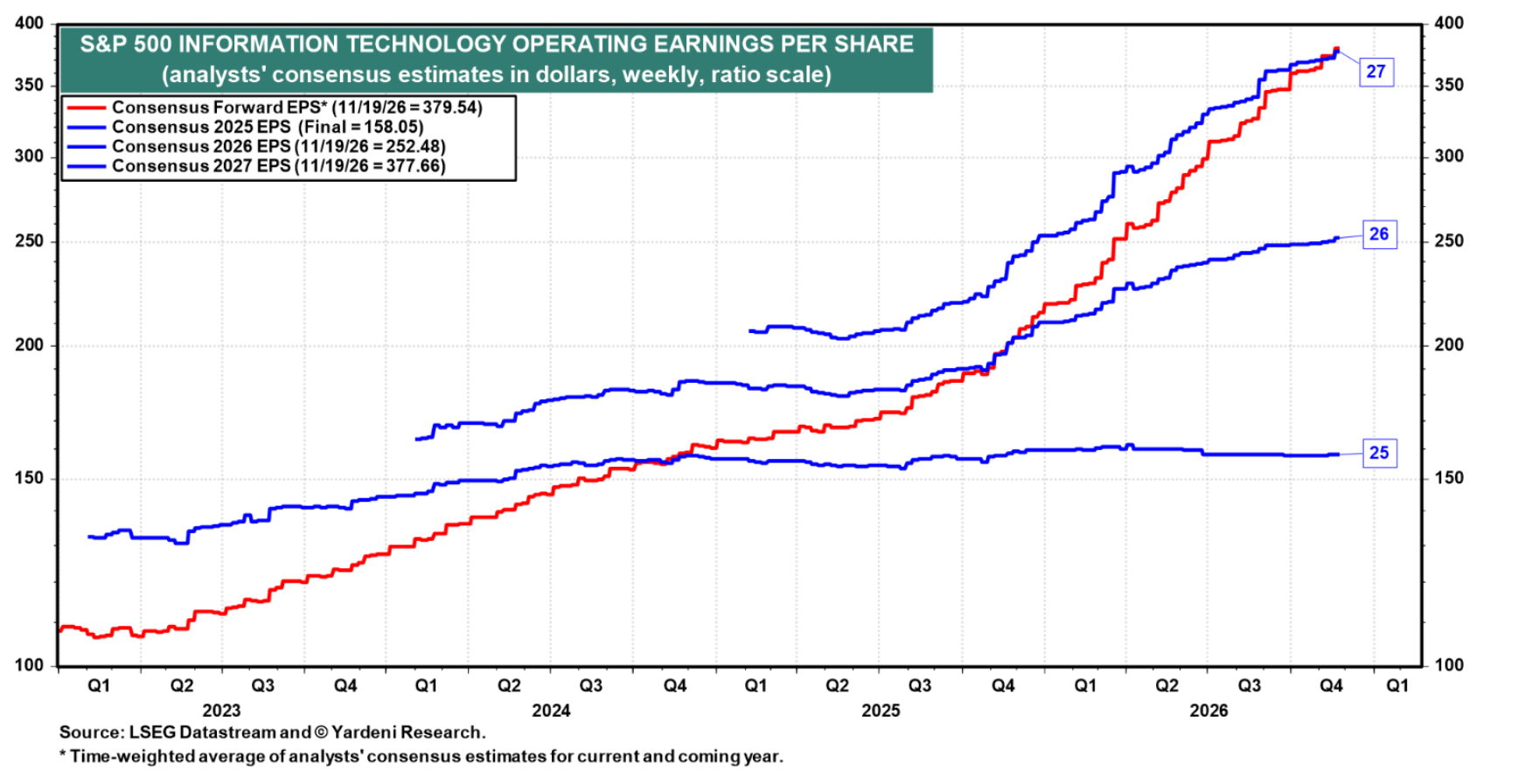
The picture isn't uniform across sectors. Consumer staples forecasts still tend to follow the familiar pattern of declining expectations as the year approaches, although projected growth remains higher than in previous years. Information technology, by contrast, has seen forecasts for 2027 rise substantially, with expectations now nearly double what analysts anticipated a year or more ago.
Growth stocks are also looking relatively attractive compared with value stocks. Their forward price-to-earnings ratios are now nearly identical, a relationship that has historically been unusual and among the most favourable for growth stocks in more than two decades.
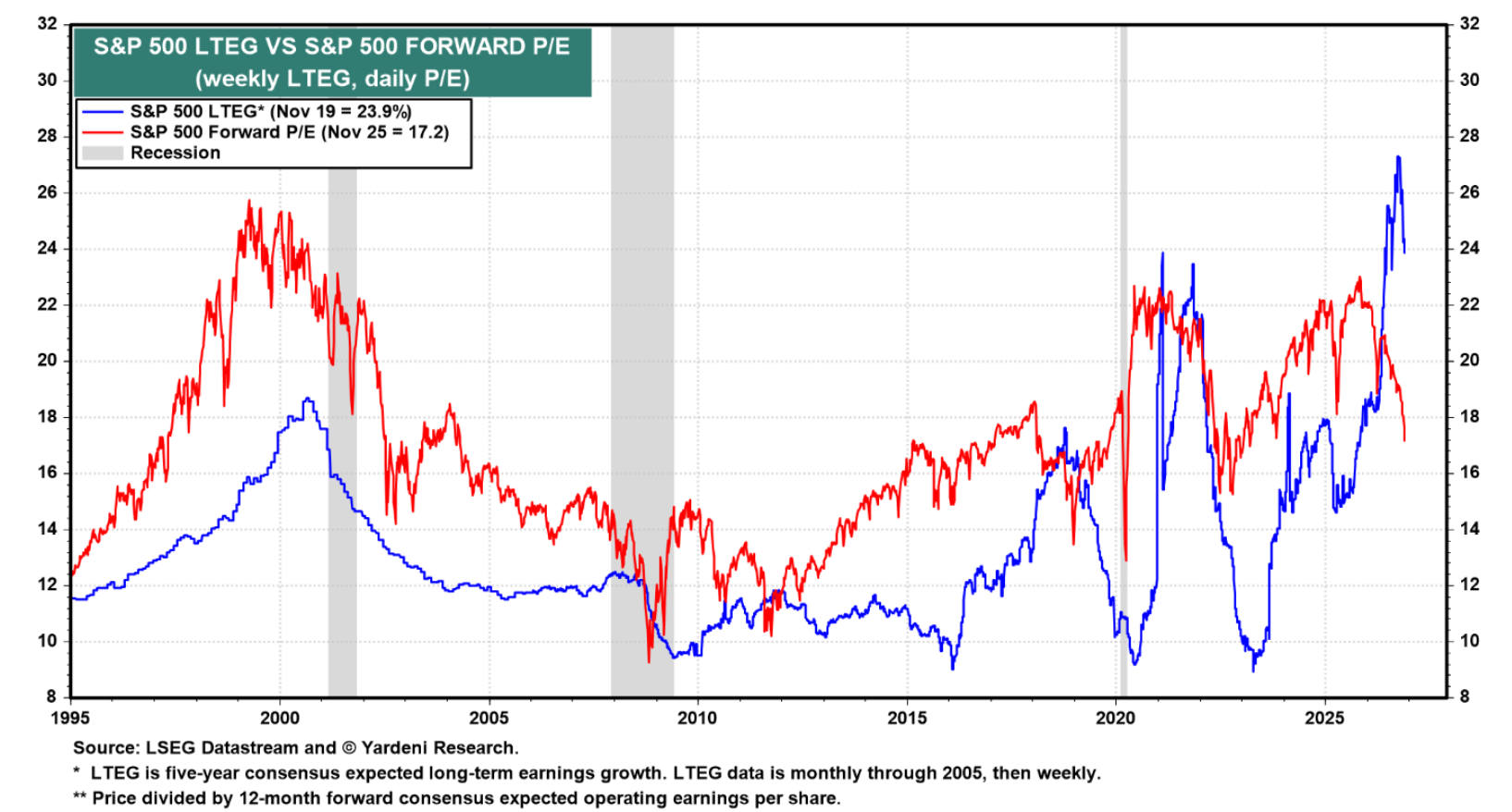
Of course, exceptionally high growth forecasts also introduce risk. Analysts' long-term earnings estimates are unusually optimistic, raising the possibility that some of the current enthusiasm is already reflected in share prices.
Are Tech and S&P 500 Corporate Profit Margins Sustainable?
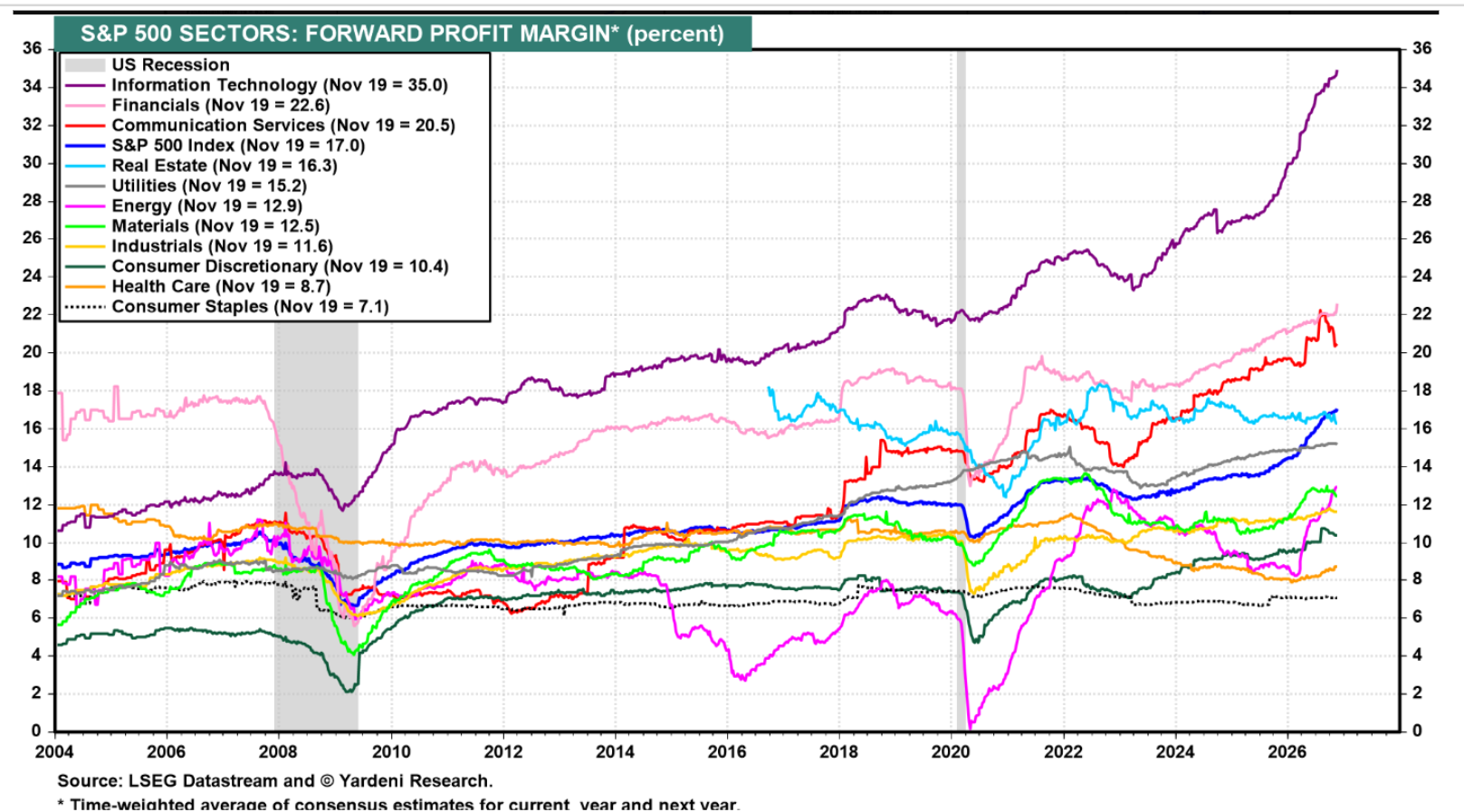
Corporate profit margins have risen substantially over the past two decades. Across the S&P 500, margins have climbed from roughly 9% around 20 years ago, to around 10% before the financial crisis, falling to approximately 7% afterward before recovering to around 16–17% today.
Information technology has seen an even more dramatic shift, with margins rising from roughly 10% to around 35%.
There is a temptation to assume these margins must eventually return to historical averages. But that may oversimplify how the economy has changed. Large listed companies increasingly outsource lower-margin activities to other businesses and countries, allowing them to focus on more profitable parts of the value chain.
Nvidia, for example, earns substantial margins while outsourcing manufacturing to Taiwan Semiconductor Manufacturing Company. Looking at Nvidia's margins in isolation doesn't capture the profitability of the businesses supplying the infrastructure behind it.
This also creates a distinction between consumer-led and business-led booms. In a consumer-led boom, higher prices eventually meet resistance, potentially forcing margins lower. In a business-led investment boom, one company's margins can come at the expense of another.
AI chip suppliers may currently be benefiting from strong pricing power, but that comes at a cost to companies such as Microsoft, Meta and Google, which are investing heavily in the infrastructure. If supplier margins eventually decline, some of the value could shift towards the companies buying that infrastructure.
The broader economy also hasn't experienced the same strength as corporate earnings. Leading economic indicators have been negative for several years while profits have surged, suggesting the earnings boom remains concentrated rather than evenly distributed across businesses.
How AI Productivity Gains Affect Long-Term Business Margins
AI adoption continues to generate genuine productivity improvements, particularly in information technology departments. Businesses are increasingly finding ways to reduce labour costs, speed up processes and improve efficiency.
The economics can be compelling. If a company can use AI to reduce the number of employees needed in a call centre or programming team, the cost of the technology may be significantly lower than the wages it replaces.
But the question remains: who ultimately captures those productivity gains?
At present, many businesses appear to be retaining the benefits through higher margins. Over time, however, competition could push those gains towards consumers. An engineering firm using AI to produce project estimates faster and more accurately, for instance, may eventually lower its bids to win more work from competitors.
That process could take years as businesses learn how to integrate AI effectively. But it highlights why the long-term impact of AI may be more complicated than simply assuming companies will permanently enjoy higher margins.
4 Key Risks and Signals to Watch in the AI Investment Cycle
The AI investment boom remains strong, but there are several potential pressure points worth monitoring.
- Political opposition to data centres: Resistance to new infrastructure could become more consequential if it begins preventing projects from proceeding, rather than remaining largely political rhetoric.
- Debt markets: Financing conditions for smaller AI infrastructure providers are worth watching, but problems among major hyperscalers such as Microsoft, Google and Amazon would be far more significant.
- Equity funding: Companies such as OpenAI, Anthropic and SpaceX require substantial capital to fund their planned investments. Difficulty raising money could affect both their spending and demand for AI infrastructure.
- Demand for AI: The key question is whether demand for training and running AI models can keep pace with the expansion of data-centre capacity.
AI training demand remains strong, although it is concentrated among a relatively small group of well-funded companies. For AI inference, the process of running trained models, the more useful metric is revenue generated per GPU hour, particularly under longer-term contracts. The challenge is whether demand from the broader economy will grow quickly enough to absorb the supply being built.
Investment Takeaways
The current market environment presents an interesting combination of below-average valuations and above-average expected growth. US and international equities appear relatively attractive on several valuation measures, while Australian equities remain somewhat expensive.
There are risks, particularly around the sustainability of earnings expectations, corporate margins and the financing of the AI infrastructure boom. Recent weakness in commodities, the Australian dollar, Bitcoin and other speculative assets also suggests investors are becoming more cautious about the growth outlook.
However, that caution doesn't necessarily mean the AI investment cycle is over. Demand remains strong, businesses are reporting productivity gains and the economics of AI adoption continue to encourage investment.
Rather than treating assets such as copper or data-centre land as indirect proxies for AI growth, the more direct approach may be to consider the companies actually developing and deploying the technology.
With valuations looking more reasonable and earnings expectations continuing to improve, the market seems tio be offer an opportunity to increase equity exposure, including higher-risk AI-related investments, while trimming some of the defensive holdings that have performed well.
The AI boom still has plenty to prove, but the valuation and earnings backdrop suggests the opportunity may be broader than the headlines imply.