Five years ago, during the first Trump presidency, I wrote a controversial post titled Could Trump be Right About Ethical Investing?.
At the time, Trump was attacking "activist" pension funds. My argument was that while I disagreed with his stance on climate change, he had a valid point about agency: Why should a fund manager at BlackRock get to decide how your retirement savings vote on social issues?
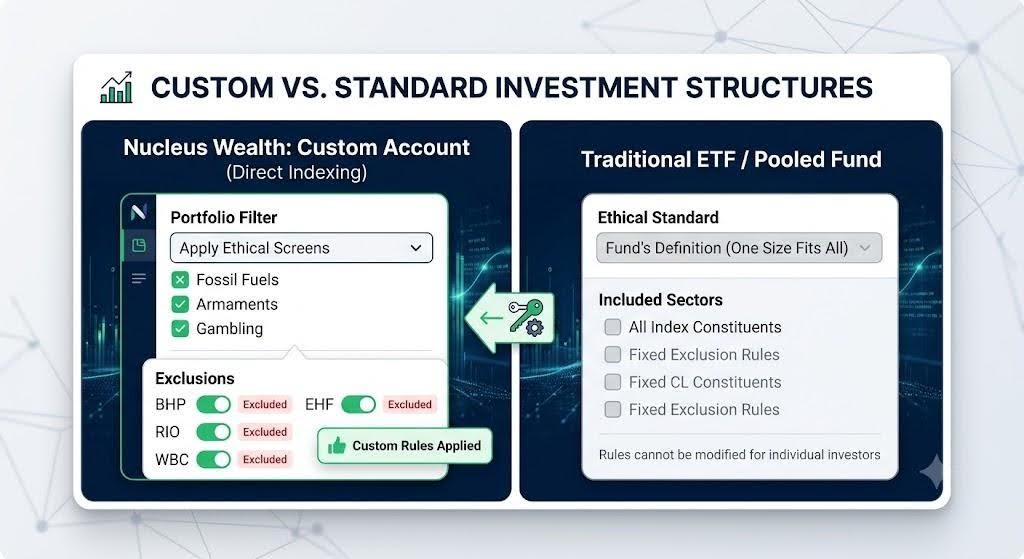
And I'm not unbiased in this debate. We run tailored ethical funds, where investors choose from 150 different ways to add or remove companies. About 2/3rds of our clients have selected at least one ethical option.
Fast forward to December 2025. Trump is back in the White House, and the Cold War on ESG has turned hot.
The administration’s recent moves—specifically the December crackdown on proxy advisors—have vindicated that original 2020 thesis. The era of "one-size-fits-all" ethical funds is effectively dead. Here is why the landscape has broken, and why Direct Indexing is the only survivor.
1. The Proxy War is Over (The "Voting" Ban)
In 2020, the concern was theoretical. Today, it is legal. On December 11, the White House issued an Executive Order targeting the "duopoly" of proxy advisors (ISS and Glass Lewis), accusing them of prioritising "radical political agendas" over investor returns.
Whether you agree with the politics or not, the implication for investors is massive.
-
The Old Model: You buy an ETF. The manager uses your shares to vote for "Climate Disclosures" or "Board Diversity."
-
The New Model: Fund managers are terrified of being sued or regulated for "non-pecuniary" (non-financial) voting.
The result? The "Voice" of the passive fund has been silenced. If you hold a standard index fund today, your "ethical vote" might be withheld to avoid a subpoena.
2. The Rise of "Greenhushing"
In my 2020 post, I noted that Trump's deregulation would make it harder to find good data. That has morphed into a phenomenon called "Greenhushing."
Fearing backlash from the White House and "Anti-Woke" litigation, major US corporations have stopped talking about their sustainability goals. They might still be cutting emissions (to save money), but they are scrubbing the word "ESG" from their reports.
This breaks the standard "ESG Rating" model.
-
Rating Agencies rely on public disclosure.
-
Corporations are now hiding that disclosure.
-
The Result: ESG scores are becoming even more unreliable than they were five years ago.
3. The "Pecuniary" Standard
The Department of Labor is currently reversing the Biden-era rules, pushing back to a strict "Pecuniary Factors Only" standard. This means fiduciaries (people managing your money) must ignore environmental or social factors unless they have a direct, proven link to financial return.
This creates a paradox:
If a company has a corrupt board (G) or is building hotels on a sinking coastline (E), those are financial risks. But under the new scrutiny, managers are scared to touch them.
4. The "Trans-Atlantic Divorce"
In 2020, we assumed "Global Ethical Standards" would emerge. We were wrong. The world has split in two:
This means a "Global Ethical Fund" that satisfies a European regulator and a US President is much harder.
The Solution: Democratize, Don't Standardize
Trump’s crusade has proven one thing: Institutions cannot be trusted to be your moral compass.
If they try to be "Woke," they get sued by Republicans. If they try to be "Anti-Woke," they get sued by Democrats (or European regulators).
The only solution is to remove the middleman. Use Direct Indexing:
-
Don't rely on a fund manager to vote for you.
-
Don't rely on a Black Box ESG score that look like a random walk between providers and might be illegal in the near future.
-
If you want to exclude Gun stocks because you dislike violence, that is your right. If you want to include Defense stocks because you support national security, that is also your right.
Trump can ban BlackRock from forcing ethics on companies. But he can’t ban you from reflecting your own values in your own portfolio.