
Australia’s 2026 CGT Shake-Up: A Survival Guide for the Growth Investor

It’s been a busy week in the wake of the Federal Budget, and the 2026 CGT shake-up is easily the biggest topic in my inbox. For years, the "50% discount" was the holy grail of Australian investing. Now that it’s being traded in for a return to cost-base indexation and a 30% minimum tax rate, a lot of people are worried.
The immediate reaction from many commentators has been: "Growth is dead; yield is king." But before you sell your high-growth tech and pile into term deposits or high-dividend yield stocks, we need to look at the math.
In most cases, capital gains still win—it just requires a slightly sharper pencil to see why.
1. The New Regime: What Actually Changed?
Starting 1 July 2027, the 50% CGT discount is gone for individuals, trusts, and partnerships. In its place, we have:
- Cost Base Indexation: You only pay tax on the "real" gain (the amount your asset grew above inflation/CPI).
- The 30% Minimum Floor: If you sell an asset, you pay a minimum of 30% tax on that real gain, even if your marginal tax rate is lower (though there are exemptions for pensioners).
- Grandfathering: Gains made before July 2027 still get the old 50% discount.
Essentially, the government is trying to stop people from "timing" their sales for low-income years to pay zero tax.
2. Why Growth Still Beats Income
The argument making the rounds is that if capital gains are taxed at "at least 30%," but your income tax rate is below that, you should prefer dividends.
This is a classic "tax tail wagging the investment dog" mistake. While capital gains are objectively less attractive than they were under the old rules, you still have to be in a very specific (and relatively rare) set of circumstances to prefer income over growth.
The secret weapon of growth isn't the tax rate—it's the tax deferral.
3. The 20% Marginal Tax Rate Scenario
Let’s look at a lower-income investor with a 20% marginal tax rate over a 10-year horizon. We have two options:
- Option A (The Income Play): A 6% annual yield. You pay 20% tax every single year on that 6%.
- Option B (The Growth Play): A 2% yield and 4% capital growth. You pay 20% tax on the small dividend every year, but you defer all tax on that 4% growth until you sell in year 10.
Under the new rules, when you sell in Year 10, you hit that 30% minimum tax floor. Even though you were paying 20% on your income, you now owe 30% on the gain.
The Verdict: Even with that "penalty" tax at the end, you end up roughly even over 10 years. Why? Because the money you didn't pay in tax during years 1 through 9 was busy compounding for you.
Crucially: If your tax rate is anything higher than 20%, the growth fund wins hands down. If you are on a 37% or 45% marginal tax rate, the benefit of deferring that tax is so massive that the 30% floor at the end is an afterthought.
4. The "Growth Alpha"
The scenario above assumes both funds return the same 6% total. In reality, growth-focused funds typically target higher total returns to compensate for the lack of immediate cash flow.
If a growth fund returns 7.25% (a 1.25% "premium") versus a 6% income fund, the math isn't even close. Even if you have a 0% tax rate today, you’d still be better off in the growth fund because the higher raw return outweighs the eventual tax bill.
5. Decision Matrix: Income vs. Growth
This table shows which strategy leaves you with more money after-tax based on your tax bracket and the "Growth Alpha" (how much extra return the growth fund provides over the income fund). All figures are based on a 6% income return and 10 years.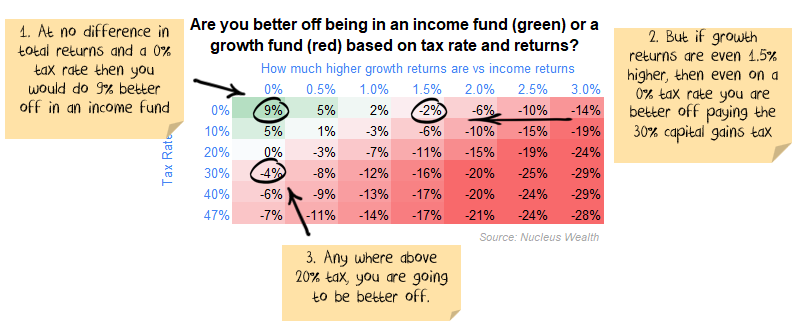
- Red = Better in Growth
- Green = Better in Income
And, this doesn't account for the fact that if you are on a 0% tax rate, you are more likely to be a pensioner in retirement and possibly be exempt from the extra charge anyway.
6. The Duration Effect
Time is the great amplifier. If a strategy is slightly better over 3 years, it will be significantly better over 10 years.
If you are a short-term trader, the tax deferral doesn't have time to work its magic, and the new 30% floor might actually hurt you. But for the long-term investor, time works in your favour. If you weren't going to switch strategies based on a 5-year outlook, a 10 or 20-year outlook makes the case for growth even stronger.
7. The Ultimate Safe Haven: Superannuation
If these new rules feel like a headache, there is one very large, tax-concessionally-treated aspirin: Superannuation.
With individual tax rules getting tighter, the super system becomes even more attractive. For many, it’s now the only logical place to hold growth assets.
- The $2.1m "Golden Ticket": From 1 July 2026, the General Transfer Balance Cap is set to increase to $2.1 million. If you can get your balance up to this level and move it into the pension phase, the tax rate on all income and capital gains drops to 0%. In this environment, all the math about 30% floors and indexation becomes moot.
- Accumulation Phase Wins: Even while you are still working (accumulation phase), super funds generally retain their one-third CGT discount. This means an effective tax rate of just 10% on gains. Compare that to the new 30% minimum floor for individuals and trusts, and super is looking better than ever.
- The $3m and $10m Thresholds (Division 296): Even with the "Division 296" tax on balances over $3 million, super still holds up. For the portion of your balance between $3m and $10m, you may face an additional 15% tax on realised earnings (bringing the total to 30%). And even above $10 million, where a second threshold can push the effective rate higher, the structural benefits of holding assets in a single, low-admin environment often still outweigh the costs of holding them personally under the new 30% floor regime.
Basically, the government has made "investing in your own name" significantly more expensive, while leaving the super doors relatively open for those who can plan ahead.
The Bottom Line
The 2026 tax reforms are a clear signal from the government: capital gains are far less attractive than they were for the last few decades. However, growth is still the superior strategy for the vast majority of investors.
The power of tax deferral and compounding returns outweighs the sting of a 30% tax bill a decade from now—especially if you are paying any more than 20% as a marginal tax rate.
If you want to win under the new rules, the strategy is simple: Stay focused on long-term growth, and use the superannuation system to shield as much of that growth as possible.