After speaking with Martin North about the Australian housing market, his key point was: there is no single Australian property market. National house-price figures can give us a useful headline, but they can also hide very different conditions between suburbs, cities and household types. The more useful question for investors is not simply whether Australian property prices are rising or falling, but which households and locations are most exposed to the pressures building underneath the market.
Martin describes Australian housing as something of a “three-body problem”. The analogy is useful because housing is being shaped by several forces at once: supply and demand, interest rates, government policy, migration, household finances and the way Australians think about property as an investment.
These forces interact, meaning that a policy intended to support one part of the market can produce unintended consequences elsewhere.
How Rising Household Debt Shapes Australian Mortgage Risk
Martin highlights that one of the most important changes over the past two decades has been the amount of debt required to buy a home.
Martin contrasts the typical borrower around 2000, who might have relied on one full-time income and part of a second while borrowing around three times income, with today's borrowers, who may require two full incomes and borrow six, seven or even eight times their income. Mortgage terms have also lengthened, with loans commonly running five to ten years longer.
That matters because higher property values are only sustainable for households if the associated debt can continue to be serviced. When borrowing capacity expands, prices can rise with it. But the reverse is also true: when borrowing costs increase or household incomes come under pressure, highly leveraged buyers have less room to absorb the change.
Interest rates, therefore, remain an important transmission mechanism. The discussion took place against a cash rate of 4.35% and renewed expectations of further increases, following concerns around inflation, oil prices and government debt. Higher rates do not necessarily cause an immediate wave of forced sales, but they increase the amount of household income being directed towards mortgages and reduce the amount available for everything else.
Martin notes that looking only at house prices can be misleading. The more important variable is household cash flow. A household can own a property that has barely fallen in value and still be under considerable financial pressure if mortgage payments, taxes, utilities, transport and other costs have risen faster than disposable income.
The outer suburbs are particularly exposed
That distinction helps explain why some of the most significant housing pressures are emerging in particular locations rather than uniformly across Australia.
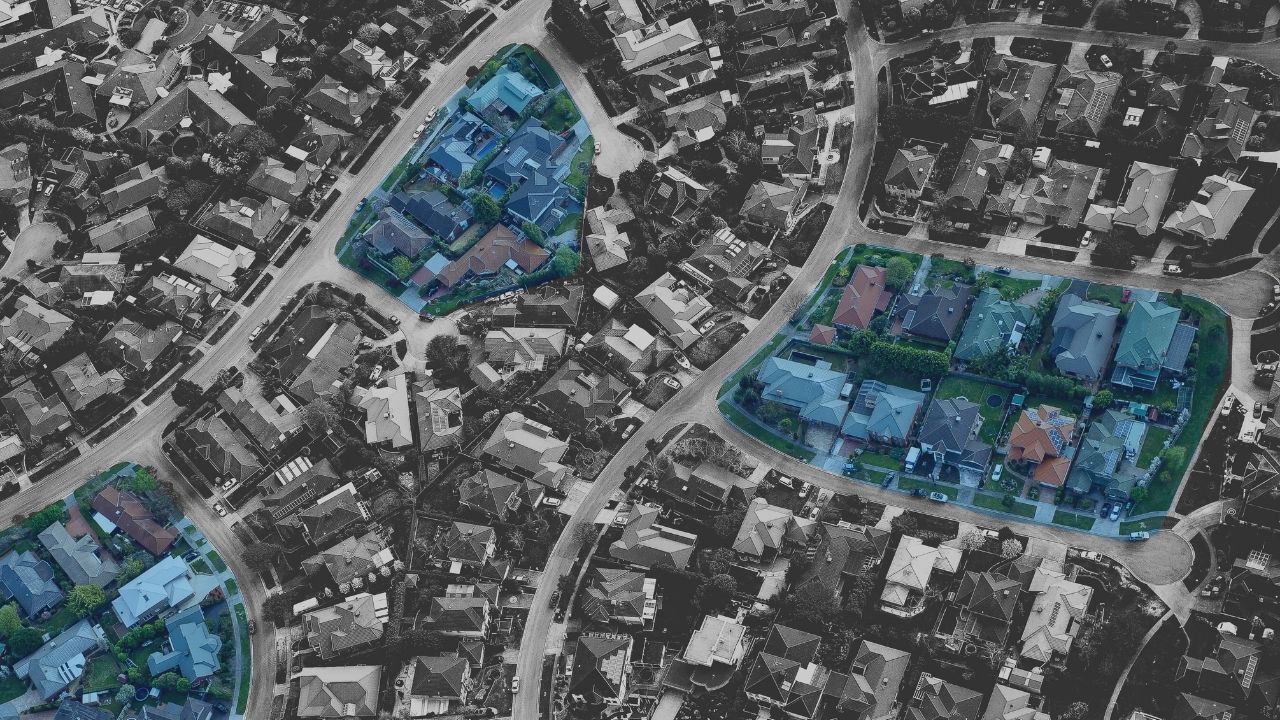
The discussion highlighted outer-suburban developments where households purchased large homes on relatively small blocks, often using substantial mortgages and relying on two incomes to make the numbers work. These households are exposed not only to mortgage costs but also to rising fuel, electricity, gas, council charges and other living expenses.
Martin's analysis therefore looks beyond the mortgage itself. His measure of stress considers the full flow of money into and out of a household. That produces a very different picture from a simple mortgage-to-income ratio because two households with identical mortgages can have very different financial circumstances.
This is also why he thinks the distinction between percentage stress and the number of households affected is important. A small, highly stressed market and a large outer suburb can have very different implications for the broader housing market.
Melbourne and Brisbane show different forms of weakness
Melbourne provides another example of why national averages can obscure the underlying story.
The discussion pointed to investor losses, property taxes and additional costs as factors contributing to investor exits from parts of Melbourne, including some outer suburbs and high-rise locations such as Docklands. Martin describes many listings as remaining on the market for more than 180 days, while some owners continue to hold out for prices that buyers are no longer willing to pay.
He estimates that around 60% of Melbourne property investors are losing money on a cash-flow basis. At the same time, prices have not risen substantially over the preceding four or five years, leaving investors facing a combination of weak capital growth and negative cash flow.
Queensland presents a somewhat different situation. Investors benefited from stronger gross returns during the earlier upswing, but the discussion suggested that prices from the Gold Coast through to the Sunshine Coast had begun turning lower. Brisbane also faces its own structural pressures, including rising apartment strata costs and building defects that can materially increase the cost of ownership.
These examples reinforce his broader point: a property market can weaken for very different reasons. In one location, it may be investor cash flow, in another, construction costs or apartment defects, and elsewhere, it may simply be that household incomes can no longer support the level of debt required to buy.
Stress does not automatically mean defaults
Perhaps the most important distinction in the discussion was between financial stress and outright default.
A household can remain under pressure for years before reaching the point where it cannot meet its obligations. Martin describes a potential progression from initial budget pressure, through missed payments and hardship arrangements, to more severe financial difficulty or insolvency. He estimates that this process can take three to five years.
That means today's stress data should not be interpreted as an immediate forecast of mortgagee sales. Banks can offer hardship arrangements, borrowers can refinance or extend loan terms, and households can cut spending or sell assets to preserve their mortgage payments.
But these measures can also delay the recognition of financial difficulty rather than eliminate it. If a household's income remains insufficient relative to its costs, extending the loan does not fundamentally change the underlying cash-flow problem.
For investors, Martin makes an important distinction. Credit stress is often a process rather than an event. The absence of widespread forced selling today does not necessarily mean the underlying household balance-sheet pressure has disappeared.
Rental stress creates another layer of pressure
The same cash-flow problem exists on the rental side of the market.
Martin's analysis puts rental stress at 75.3% of the rental sector, while mortgage stress is reported at 53.8%, compared with 32.9% before the pandemic. His national sample implies that with around 10 million households, with approximately 2.2 million are in mortgage stress, 2.3 million in rental stress and 5.1 million in broader financial stress.
Central Melbourne, Liverpool, Toowoomba, Tarneit, Westmead and several other locations feature prominently in the rental-stress data.
-
For landlords, however, rising rents do not automatically translate into attractive investment returns. Martin makes an important distinction between gross yield and net yield. Once vacancy, interest, insurance, council rates, strata, management fees and land tax are included, the actual cash return can be considerably lower than the headline rental yield suggests.
This is particularly relevant when property prices are high relative to rents. A landlord can receive a rising rent while still losing money after financing and other costs.
What happens next?
Martin's three scenarios illustrate how sensitive the market remains to the interaction between rates, inflation, migration, employment and government policy.
-
His most benign scenario assumes rates remain around 4.35%, migration stays above average and some government support continues, resulting in broadly flat national house prices over three years.
-
His base scenario assumes rates rise to 4.6%, unemployment increases and economic growth weakens, producing a 13% decline in average house prices.
-
His most severe scenario assumes rates rise above 4.85%, inflation persists, unemployment rises and stagflation emerges, resulting in a 33% decline.
These are conditional scenarios rather than certainties.
My takeaways
There are some real risks brewing in the housing market.
However, successive Australian governments (and regulators) have been more than happy to change the rules or throw more money at the problem every time this has occurred over the last few decades.
If you have faith that politicians will reverse course as soon as the going gets tough, the outcomes will be more benign.
I think politicians reversing course is a very likely outcome. The question is whether they move fast enough when the time comes - and that is where the danger lies. If they are too late, then in a weak economic environment, the "safe as houses" Australian investment psyche might break enough to see quite negative economic impacts.
Investment Impacts
More caution on Australia, particularly the domestic economy and banking sectors.
Basically reinforcing many of our existing themes. Overweight international has been the right call for years now, and I don't think it is time yet to swing back the other way.