
SpaceX’s AI Data Centre Bet Could Be a Spoiler for the Entire Industry

For me, the most interesting investment question involving SpaceX isn’t whether it is worth the enormous valuation. It’s whether Elon Musk can build AI data centres quickly enough to change the supply-demand balance of the entire industry.
That distinction matters.
SpaceX’s valuation is one question. Its potential to disrupt the data-centre market is another. Even if investors ultimately decide that SpaceX is too expensive, its approach to building AI infrastructure could still have major consequences for companies currently earning unusually high returns from scarce computing capacity.
Saved from itself
For all of the comparisons with the railroad boom or the internet boom, my thesis has been that the constraints on building datacentres have saved the industry from itself. So far.
Compute prices have remained high because supply constraints have, to date, prevented an overbuild.
One day, there will be an overbuild. The question is whether that is six months away or six years away.
The economics of AI compute are incredibly attractive
AI data centres make money by selling compute — access to the processing power needed to train and run artificial-intelligence models.
Right now, that compute is scarce. And when something is scarce and demand is strong, prices can rise well above what might be considered a sustainable long-term level.
Recent Semianalysis estimates illustrate just how powerful that scarcity can be:
-
A 1GW data centre operating under long-term contracts with a Neocloud provider generates roughly $12 billion in revenue.
-
Selling that same computing capacity on demand could generate almost $30b. SpaceX has recently struck a deal with Google for almost $50b.
- By selling inference directly to the end customer, the revenue is $100b.
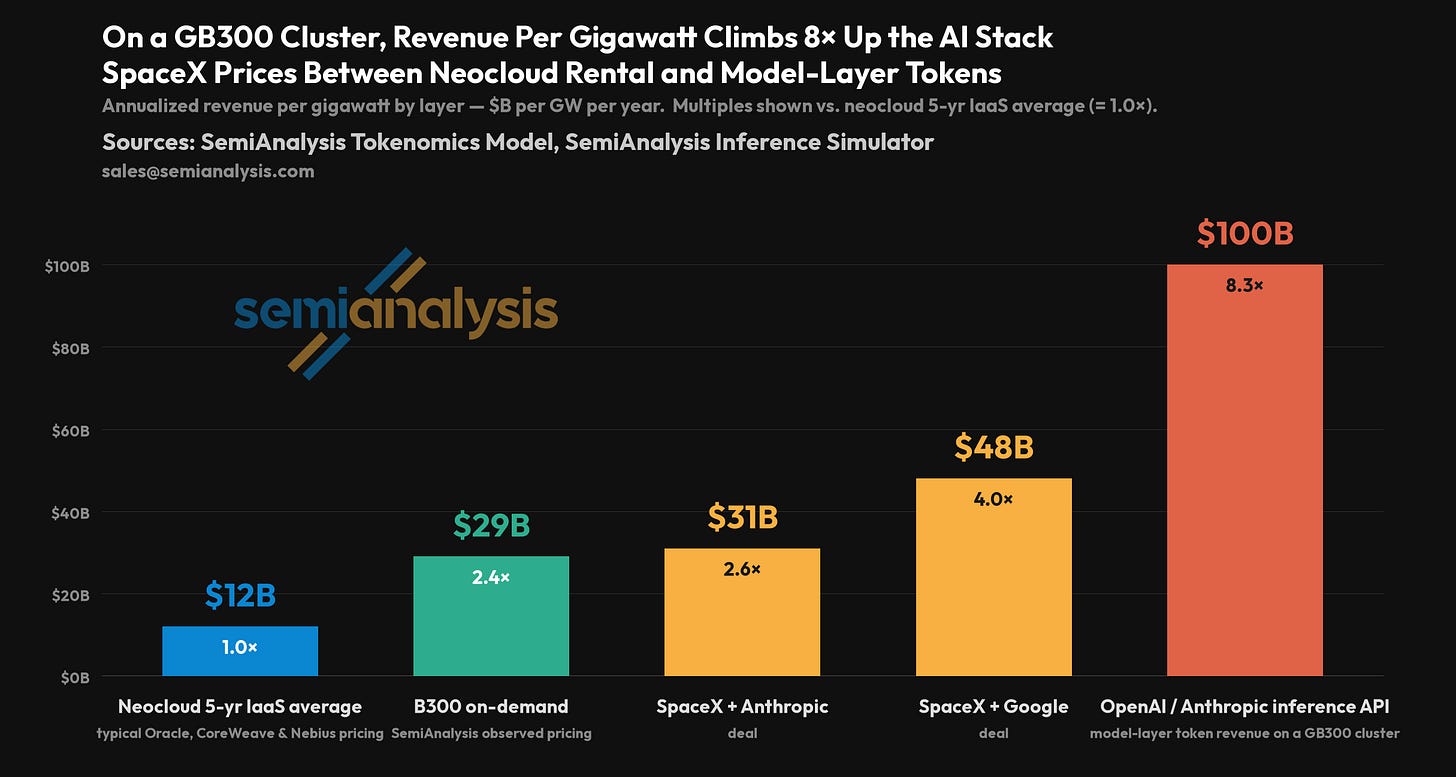
Call the cost of a 1GW data centre $50b - noting that you might be able to almost halve or almost double that number depending on a range of factors.
Regardless, the economics at $12B are attractive. The economics at $100B are extraordinary. Basically your money back in less than a year. Which is why there is a mad rush to build.
How steep is the demand curve
The 1 trillion dollar question.
Say currently there is 10GW of compute for inference at $100B = $1t of demand.
If next year there is 40GW available, do prices fall 20% and there is 40 x 80 = $3.2t of demand? Or do prices fall 40% and there is 40 x 60 = $2.4t of demand? Or is the $1t of demand price agnostic, and so it stays constant and prices fall 80%?
Or, to put it another way, if prices for AI compute fell, would demand:
-
Only rise a little. i.e. the demand for AI compute is largely being met, and a fall in price is a cost saving
- Rise a bit. i.e. the demand at cheaper prices creates more options to use AI
- Rise exponentially. i.e. there is large, unmet demand for AI which is being stifled by current high prices
I don't know the answer, I suspect it it somewhere between 2 and 3, but I don't think anyone really knows.
If instead it is somewhere between 1 and 2, then the economics can be self-defeating. It is a classic boom-bust mechanism: high prices encourage investment, investment creates supply, supply reduces prices, and lower prices undermine the investment case.
The industry may be building into a supply flood
There are already around 40GW of data-centre capacity under construction.
At today's scarcity-driven prices, the theoretical revenue associated with that capacity looks enormous. But that number is misleading if those prices only exist because supply is constrained.
Once the new facilities come online, customers will have more options. Data-centre operators will have more competition. And the extraordinary prices being charged for scarce compute may not survive.
That doesn’t necessarily mean AI demand is weak. It means that revenue growth and demand growth are not the same thing as pricing power.
This is where SpaceX becomes particularly interesting.
Musk’s strategy: build fast, not perfectly
Musk has a long history of making ambitious predictions that do not always arrive on schedule. Self-driving cars are an obvious example.
But it would also be a mistake to dismiss every ambitious Musk target simply because some have been overly optimistic.
The same engineering-led approach has helped produce genuine disruption in reusable rockets, satellite internet and electric vehicles.
His stated target is to bring 10GW of data-centre capacity online in 2027.
That is an enormous number, representing more than a quarter of the additional capacity in the forecast discussed above. But the more interesting question is not whether SpaceX can hit 10GW.
It is whether Musk's approach changes what the industry considers possible.
Rather than waiting years to build a conventional data centre, SpaceX appears willing to compromise.
Existing industrial buildings can be retrofitted rather than waiting for ideal greenfield sites. Temporary or modular power systems can be used instead of waiting for a permanent grid connection. Less established suppliers can be considered. Components can be preassembled and installed in modules. Construction, electrical work and mechanical work can also be carried out in parallel rather than sequentially.
The rapid construction for Colossus One is an example of how quickly this approach can produce capacity.
That is important because the traditional data-centre model is designed around a very different objective.
Fast, cheap or good?
The old project-management principle is that a project can generally optimise two of three things: fast, cheap and good.
A conventional hyperscale data centre is designed to be good and reliable for a very long time.
Companies such as Amazon and Microsoft build facilities expected to operate for perhaps 20 or 30 years. That means reliability, redundancy, energy efficiency, long-lived equipment, careful commissioning, established suppliers and long-term customer contracts all matter.
SpaceX may be optimising for something else entirely.
Instead of building the perfect data centre for the next 30 years, the strategy could be to build a good-enough data centre right now, while compute is scarce and prices are high.
A facility that is slightly less efficient, somewhat more expensive to operate or useful for only a few years may still make sense if it can begin generating revenue years earlier.
The economics can be surprisingly compelling.
If a data centre can earn ten times the normal revenue for four years because it captures a period of extreme scarcity, that could potentially be more attractive than earning normal revenue for 40 years.
In other words, time itself becomes an economic advantage.
And that could be bad news for everyone else
This is where SpaceX could become a market spoiler.
If Musk demonstrates that AI data centres can be built dramatically faster than conventional operators expect, others may copy the strategy.
Suddenly, the industry might not be looking at 40 or 50 gigawatts of new capacity. It could be considerably more.
The sequence is relatively straightforward.
Faster construction brings computing capacity online sooner. More capacity reduces scarcity. Less scarcity reduces the premium customers are willing to pay. Lower prices reduce the profitability of new data centres.
And once that happens, the earnings expectations supporting the current AI infrastructure boom could start to unravel.
That doesn't mean a collapse is inevitable.
Is there latent demand?
There is another possibility: cheaper compute creates much more demand.
If AI becomes significantly cheaper to run, applications that are currently too expensive could suddenly become viable. AI-generated video is one example. More businesses could use AI. More consumers could access AI services. The overall market could grow enough to absorb the additional capacity.
But there is a competing possibility.
Perhaps the world does not create dramatically more AI demand. Instead, the same pool of spending is simply spread across more providers offering cheaper services.
There are already potential sources of pressure. Chinese AI models could provide cheaper alternatives. Open-weight models can be downloaded and run without paying a cloud provider for every inference. Some AI workloads can increasingly be handled locally on personal computers.
At the same time, companies such as OpenAI and Anthropic are competing for many of the same customers.
So falling prices could either expand the market or simply redistribute it.
The investment question
The investment thesis here is therefore not whether SpaceX is a good investment. In fact, the valuation question is completely separate from the macroeconomic question.
Can SpaceX become a spoiler for the AI infrastructure boom?
The market may currently be correct that there is not enough compute. But that doesn't mean there won't be enough compute two or three years from now.
The key variables are how quickly new capacity arrives and whether demand grows quickly enough to absorb it.
For investors, that means watching the physical world rather than simply the headlines around AI demand. How quickly are data centres actually being built? How much power can operators secure? Are temporary power solutions becoming more common? Are construction timelines falling? And, most importantly, are compute prices beginning to come down?
The irony is that one of the biggest risks to the AI infrastructure boom may not be disappointing AI demand. It could be AI infrastructure becoming too easy to build.
I think that is what makes Musk’s strategy worth watching. The biggest threat to an industry built around scarcity may not be a lack of demand, but an engineer finding a faster way around the bottleneck.
Navigating the Rapid Shift in AI Infrastructure
As SpaceX and fast-scale builders redefine how quickly computing capacity can reach the market, knowing where capital is safe—and where pricing power is at risk—becomes crucial for long-term growth. If you want to understand how these structural infrastructure shifts impact your portfolio, book a meeting or talk to our team today to align your investment strategy with evolving global trends.