
September 2026 Performance Report

September was all about the bond market. The US Federal Reserve raised rates for the first time since 2023, the Reserve Bank of Australia lifted the cash rate to 4.60%, and the US 10-year Treasury yield jumped from 4.8% to 5.3%, its highest level since 2007. Oil added to the pressure: Brent rose 14% to around US$104 a barrel as the Middle East conflict spread to shipping in the Strait of Hormuz. The ASX 200 fell 3.2%, but our portfolios held up well, the Tactical Growth up 0.3%.
In the US, the S&P 500 was roughly flat and the Nasdaq rose 1.9% on the back of AI stocks. Gold fell almost 7%. For Australian investors, a 2.4% fall in the Australian dollar (back below US70c) turned flat offshore markets into gains.
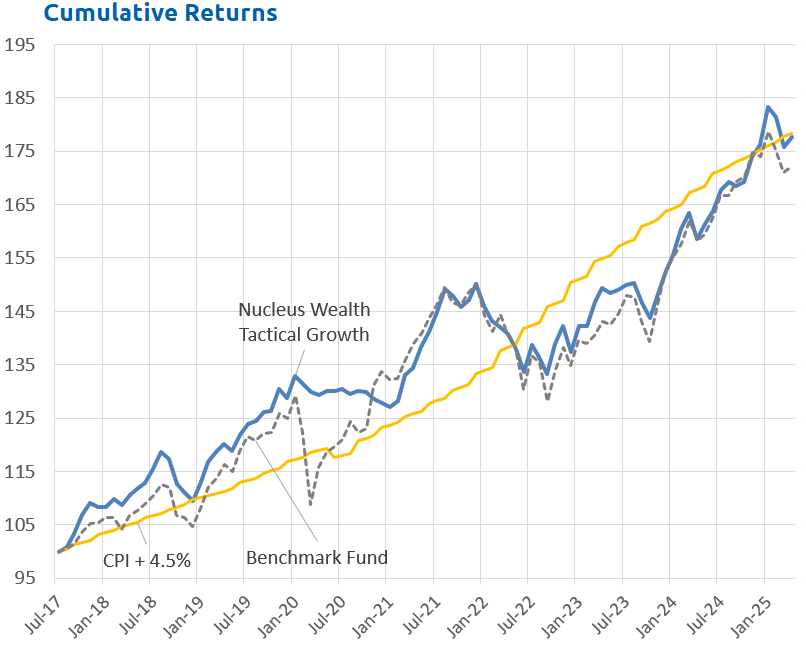
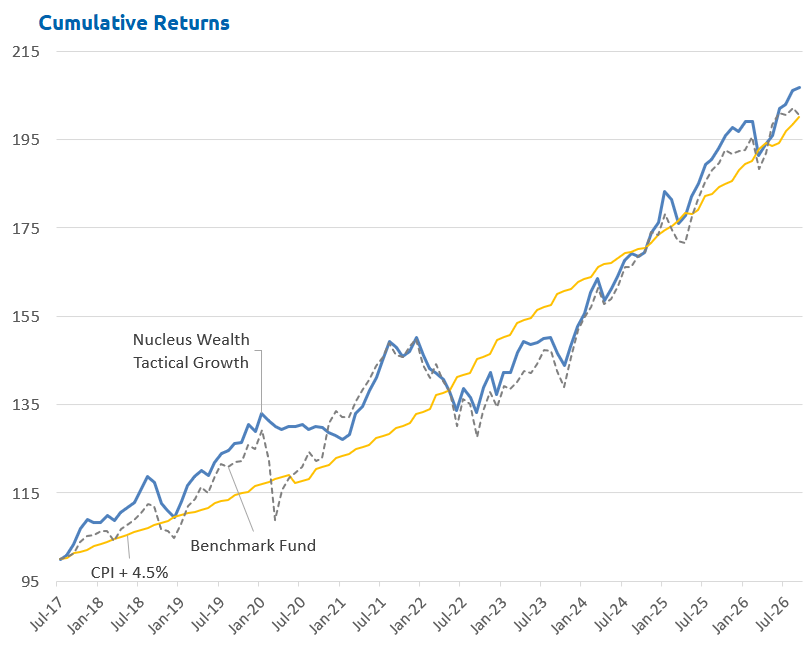
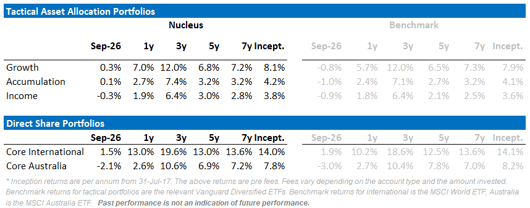
Our portfolios held up well. Global Direct Index was the standout, up 3.8% after fees against 1.9% for the MSCI World. All three tactical portfolios beat their benchmarks. Our Australian portfolios fell with the local market but lost less, with Core Australia down 2.1% against 3.0% for MSCI Australia.
Strong shares and high yields don't usually go together. This month, I explain why I think they can for now, what would change my mind, and why Australia looks riskier than the rest of the world.
Earnings, AI and the Two-Speed Economy
The NASDAQ is back at all-time highs, and the S&P 500 isn't far off. At the same time, long-bond yields have climbed back to their pre-global financial crisis levels. Strong shares and high yields don't usually go together. This month, I want to explain why I think they can for now, what would change my mind, and how we're positioning portfolios.
Valuations are better than the headlines suggest
Markets at all-time highs sound expensive, but valuations tell a different story. The 12-month forward P/E on global equities is not that much higher than its long-run average, at about the 60th to 65th percentile. Prices have gone up, but earnings have gone up faster. The pace of earnings upgrades is the most important chart I watch, and right now, forward earnings are rising faster than at any point in the data. That includes the recoveries after the dot-com bust, the GFC and the pandemic. For the S&P 500, analysts expect roughly 34% earnings growth this year and another 17% next year. There are fair arguments that some of these earnings are of lower quality:
- AI investment earnings. Many of the larger tech stocks have holdings in other tech stocks, which have increased substantially. Most forecasts strip much of this out, but not all of it.
- Tariff refunds. Companies passed tariffs on to customers. Now that the Supreme Court has struck them down, the refunds go straight to company profits.
- Energy. Energy-sector profits are up close to 100%, but that's because of a war, not sustainable growth. High oil prices also drag on the rest of the economy.
All of that is true, but even after you discount it, these earnings are in the top 1% of anything we've seen. And it isn't just tech. Materials are up substantially, industrials are up almost 20%, and even real estate is up 14%. Plenty of sectors are growing at rates you'd be happy with in any normal market. There are plenty of negative headlines and plenty of things that could go wrong. But while earnings keep rising at these rates, it's very hard for markets to fall.
Government deficits help companies in the short term
People often point to US government debt (now over $40 trillion) as a reason for caution. In the long run, it is a problem. In the short run, it's very good for corporate profits. The household, government and corporate sectors are linked: one sector's spending is another's revenue. If governments run large deficits and wage growth stays weak, that money mostly ends up as company profits. That's a big part of why corporate margins are at records.
The economics of AI data centres
There's a steady stream of doom about AI: token prices are collapsing, companies are spending fortunes with nothing to show for it, and it will all end in tears. Token prices really are falling, but that misses the point. The economics of building and renting out AI computing power are still extraordinary. Take a 1-gigawatt data centre. It costs roughly US$40–60 billion to build, mostly on NVIDIA chips. Here's what you can earn from it:
| 5-year lease to a "neocloud" provider | ~$12bn | 4–5 years |
| 1–2 year deals with large AI companies | $30–40bn | 1–2 years |
| Selling inference directly to end users | ~$100bn | 6–9 months |
Hardware that pays for itself in under a year is what makes everyone want to build more. Capacity, measured in gigawatts, is roughly doubling each year. Each new generation of chips is also several times more productive than the last, so token output could rise tenfold or more.
The obvious risk is oversupply. I dealt with this last month, and it remains the number one risk to the AI boom. But with no real signs that oversupply is close.
Constraints may be extending the boom
Growing local opposition to new data centres, power constraints, hardware constraints are probably protecting the industry from itself. Without them, companies would have spent two or three times as much, and we might already have a glut. Limited supply keeps prices and returns high, which makes everyone want to build even more. That self-reinforcing loop is how booms get bigger. They do eventually reverse, but nobody can say whether that's six days or six years away.
Higher rates and the K-shaped economy
This is where AI and interest rates connect. If you're earning a 50–100% return on a data centre, it doesn't matter whether your funding costs 6.5% or 7.5%. If you're a retailer, a home builder or a household, that extra 1% changes the decision. Higher rates hit the bottom of the "K" much harder than the top. AI also threatens entry-level professional jobs, and that change is happening faster than past technology shifts. The gap between the parts of the economy that are booming and those being left behind is widening.
Productivity, the Fed and where rates go
I'm optimistic that there's real productivity growth and underlying deflation building in the economy. Right now, it's swamped by inflation from government spending, the capex boom, tariffs, war and energy. There may come a point, perhaps five years out, when we're asking why inflation is so low again. That's not where we are today. I have sympathy for parts of Kevin Warsh's approach at the Fed, whatever you think of his politics. He wants to focus on supply and productivity rather than only managing demand, and to step back from detailed forward guidance that pretends the Fed knows what will happen years ahead. Unfortunately, it comes at a hard time, and the net result is that interest rates are likely to stay higher for longer. Voters aren't punishing governments for running deficits, so the deficits will continue until something forces a reset.
What this means for portfolios
-
Equities over the long run. If you're worried about persistent inflation over 5–10 years, you need more equities. Property and gold have struggled during long periods of high inflation, such as the 1980s and '90s. Gold is better at protecting against sudden inflation shocks than against sustained high inflation.
-
Inflation-linked bonds. We moved meaningfully into inflation-linked bonds six to nine months ago. If inflation stays high, they pay us for it. Ordinary bonds don't.
-
Government bonds are getting close to being attractive. Our growth fund targets inflation plus 4.5%, and our lowest-risk funds target inflation plus 2.5%. If government bonds yield 6–6.5% and inflation settles around 3%, you can lock in your target return for 10 or 20 years at very low risk. We're not there yet, but the higher long-term yields go, the more attractive that becomes, and we're watching it closely.
-
Caution on credit. Corporate bonds, private credit and mortgage funds typically pay 1–2% more than government bonds. Over a full cycle, you earn that extra return and occasionally lose 7–8% in a bad year. I think we're close to that bad year: some private equity vehicles and higher-risk corporate and developer loans are already in trouble. Giving up 2% a year for two years by holding government bonds is a small price for avoiding a possible 20% loss. You can buy back in once the problems have cleared.
Australia looks riskier than the rest of the world
Most of these risks are worse for Australia. We have a housing market that's been a one-way bet for a long time, low productivity, and rising rates. Many forecasters now expect house prices to fall 10–15%.I think of the ASX as four groups:
- Resources: really international stocks, since their customers are overseas.
- Global businesses that happen to be listed here: CSL, ResMed, Cochlear, James Hardie, Brambles. These belong in your international allocation.
- Banks.
- Domestically focused companies.
The last two are what you really own when you own "Australia," and that's where the problems are. Australian banks are also the most expensive banking sector in the world, which is hard to justify if house prices fall. When people tell me they're well diversified, they often list a bond fund, bank hybrids, bank shares, an ASX 20 fund, two investment properties and their own home. That's twelve different ways of betting on the Australian housing market. If it falls, everything falls together. Think about your job too: if you work for a bank or a property developer, your salary and bonus already depend on housing, so your investments shouldn't double up on it. We have clients who work at banks and ask us to exclude Australian banks from their portfolios for exactly that reason. Diversifying overseas also helped this month. International shares returned around 4–5% in Australian-dollar terms, mostly because the Aussie dollar fell, while the Australian market was roughly flat.
Looking ahead: the US midterms
The US midterms are only weeks away. I think markets would welcome a Democratic House, and possibly a Democratic Senate. That's not about party preference. Markets would like a Trump administration with some guardrails. The bigger short-term risk is volatility in the run-up. Iran looked close to a deal a few months ago and then backed away. It's reasonable to think Iran, and possibly others, would like to see oil prices stay high and the Trump coalition under pressure until the vote. If the result is close, expect legal challenges and possible political instability. I'd expect a bumpy month.
Asset allocation
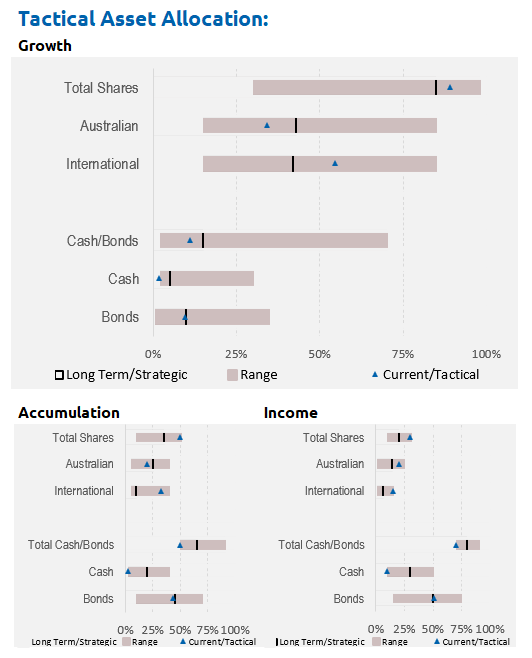
We have been winding back on our share exposure. We are overweight inflation-linked bonds. At the end of the month, the growth in international meant our allocation to shares was high:
Performance Detail
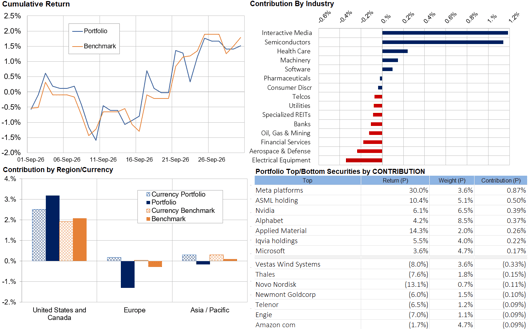
Core International Performance
Markets rallied toward the end of September, driven by the AI trade. Performance was driven by Interactive Media and Semiconductors. US remains the stock powerhouse, but the falling AUD (after some strong months) accounted for most of the performance overall.
Core Australia Performance
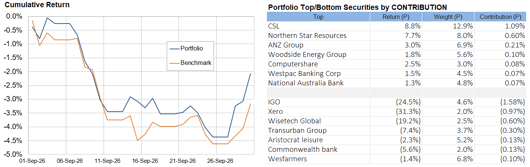
The local market headed lower in September with technology stocks and IGO the major drags. CSL continues to rally along with Banks, Gold and Energy.